
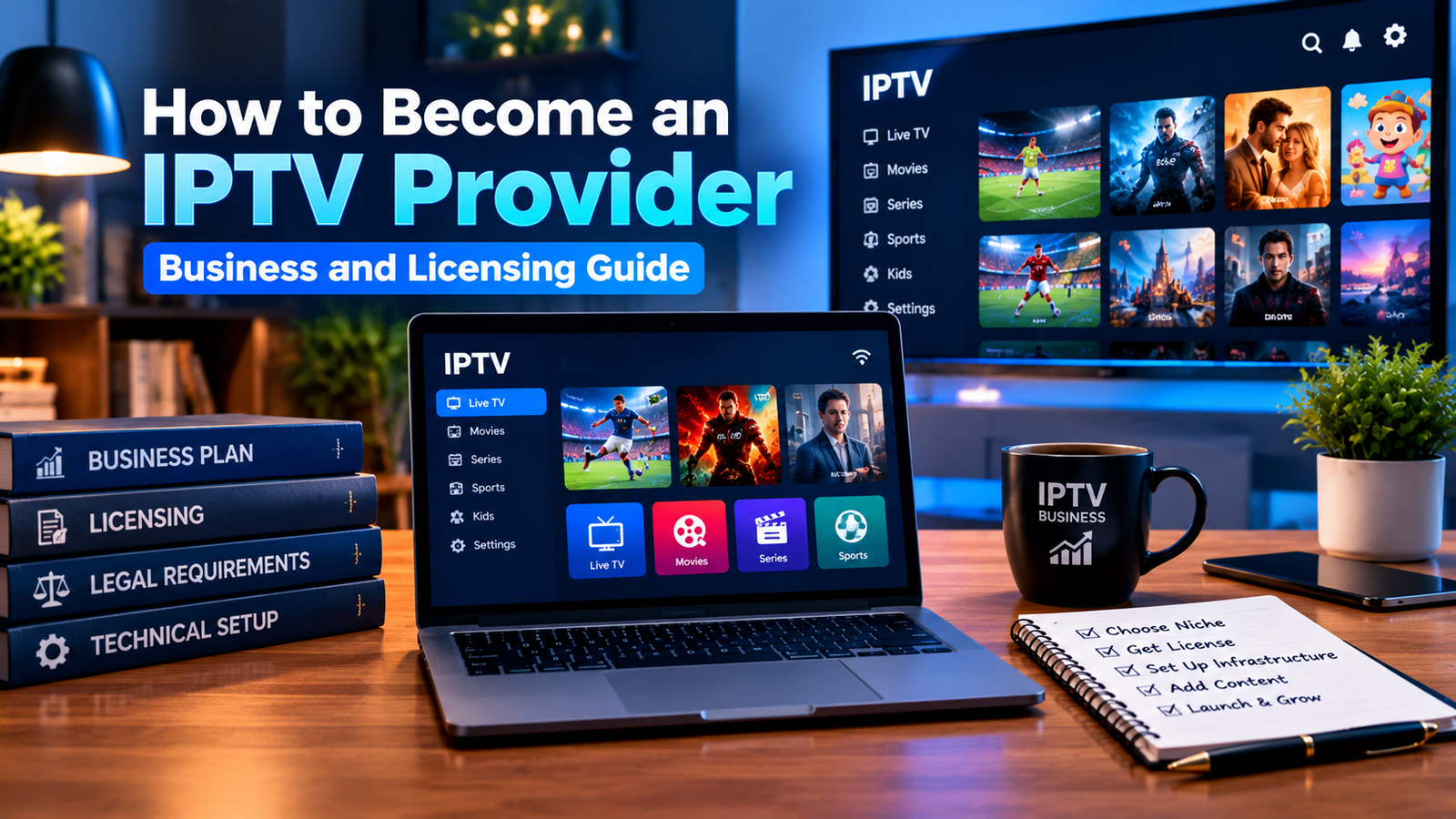
If you want to know how to become IPTV provider, the first step is not buying a server or reseller panel. A legitimate IPTV provider needs permission to distribute its content, a properly structured business, reliable streaming infrastructure, subscriber management, payment systems, compatible apps, security, and customer support.
The legal side is especially important. IPTV is simply a method of delivering television over internet networks. The content you distribute may still be protected by copyright, broadcasting rules, licensing agreements, and regional restrictions.
For that reason, becoming an IPTV provider should begin with a lawful content and business model before you build the technical platform.
What Does an IPTV Provider Actually Do?
An IPTV provider delivers authorized television or video programming to viewers over IP networks.
Depending on the business model, a provider may offer:
- live television
- video on demand
- original programming
- licensed movies or series
- pay-per-view events
- niche or specialist channels
- educational or corporate video
- broadcaster-owned content
The provider handles more than playback. It may also manage customer accounts, subscriptions, entitlements, Electronic Program Guide data, applications, billing, technical support, monitoring, and content delivery.
This is different from an IPTV player. A player such as a Smart TV or Android TV application provides the interface used to watch streams, while the IPTV provider supplies authorized access to the content.
Choose Your IPTV Business Model
Before investing in infrastructure, decide what kind of provider you want to become.
Licensed Direct Provider
In this model, your company obtains content and distribution rights directly from broadcasters, producers, distributors, sports organizations, studios, or other rights holders.
You control more of the platform, but this model normally requires the most legal, technical, and financial preparation.
Authorized White-Label or Reseller
Another option is partnering with a legitimate television or streaming platform that already holds the necessary distribution rights and explicitly permits commercial resale or white-label use.
The important word is authorized.
Access to a reseller dashboard alone does not establish that the underlying television channels or movies are licensed for resale. Review the supplier’s agreements and confirm what territories and commercial uses are permitted.
Technology Provider
You can also build IPTV technology for organizations that already own or license their programming.
For example, your business might provide streaming infrastructure, apps, hosting, subscriber management, or video delivery for a broadcaster, school, company, sports organization, or content owner.
This can avoid the need to acquire a large entertainment catalogue yourself, although contracts and other legal requirements still matter.
Secure Content Licensing Before Selling Subscriptions
Content rights are the foundation of a legitimate IPTV service.
In the United States, the U.S. Copyright Office explains that retransmitting copyrighted television programming over the internet generally requires authorization from copyright owners unless an applicable legal licensing mechanism applies.
Canada’s intellectual property authority similarly explains that copyright owners control important uses of protected works and can grant licences defining how others may use them.
Australian government guidance states that copyright material generally requires permission from the copyright owner unless an exception or statutory licence applies.
A distribution agreement should clearly define issues such as territory, duration, platforms, channels or programmes covered, commercial use, subscription rights, advertising rights, VOD rights, simultaneous viewing, and any technical protection requirements.
Do not assume that access to a consumer cable, satellite, or streaming subscription grants permission to retransmit that programming to your own customers.
Understand Country-Specific IPTV Regulations
A provider serving several countries may have different obligations in each market.
| Market | Important consideration |
|---|---|
| United States | Copyright and retransmission rights, consumer billing rules and applicable state or federal requirements |
| Canada | Copyright licensing plus possible CRTC obligations for qualifying online streaming services |
| Australia | Copyright permission plus broadcasting or SVOD obligations where applicable |
Canada currently requires certain online streaming services operating in Canada to register with the CRTC when they offer broadcasting content and earn at least CAD 10 million in annual broadcasting revenues in Canada, subject to applicable exemptions.
Australia’s current SVOD framework also includes obligations tied to service size. Certain services with at least 250,000 paying Australian subscribers have notification obligations, while qualifying major SVOD services with at least one million paying subscribers can fall under Australian content requirements.
These thresholds do not mean every IPTV startup automatically falls into those categories. Your exact obligations depend on how the service operates, so professional legal advice is appropriate before launch.
Register and Structure the Business
Once your business model and content rights are realistic, establish the company properly.
You may need:
- business registration
- tax registration
- commercial banking
- accounting processes
- customer terms
- privacy policy
- refund and cancellation rules
- content agreements
- supplier agreements
- payment-processing agreements
Your business structure should also separate customer-facing operations from technical infrastructure and content licensing records.
Keep copies of all distribution agreements. If a supplier claims you are allowed to resell programming, obtain that authorization in writing.
Build the IPTV Technical Infrastructure
The technology required depends on whether you operate the complete platform or use licensed managed services.
A full IPTV architecture can include:
| Component | Role |
|---|---|
| Content ingest | Receives authorized live or recorded media |
| Encoding and transcoding | Creates appropriate video formats and bitrates |
| Origin infrastructure | Stores or serves the primary streams |
| CDN | Distributes video closer to users |
| Middleware | Manages services, packages, EPG and users |
| Authentication | Verifies subscriber access |
| DRM or access controls | Protects licensed programming |
| Applications | Provides viewing interfaces |
| Billing platform | Manages subscriptions and payments |
| Monitoring | Tracks stream and platform health |
Your infrastructure should be designed around realistic concurrent viewing rather than total registered users.
A thousand registered accounts do not necessarily mean a thousand simultaneous streams, but major events can create sudden peaks. Capacity planning and testing are therefore essential.

Choose the Devices You Will Support
Do not promise compatibility with every device before testing it.
Decide which platforms matter to your intended audience, such as:
- Smart TVs
- Android TV
- mobile devices
- web browsers
- Apple TV
- selected streaming devices
- computers
Supporting additional platforms increases development, quality assurance, and customer-support requirements.
Reviewing real installation workflows can help when planning your user experience. The Zyra IPTV IPTV setup guides show examples of the steps viewers may encounter when configuring television and streaming devices.
The goal for your own service should be simple onboarding with clear official instructions.
Build Subscriber and Entitlement Management
A professional IPTV provider needs to know who should be able to watch what.
Subscriber management may include:
- customer accounts
- subscription status
- packages
- content entitlements
- device management
- simultaneous stream rules
- password recovery
- trial access
- account suspension
- cancellation
Entitlements are particularly important when licensing agreements limit certain channels or programmes to specific countries or subscription plans.
Avoid giving every subscriber unrestricted access simply because the technology allows it.
Set Up Billing Transparently
Subscription businesses need clear pricing and cancellation procedures.
Before charging customers, explain:
- price
- billing frequency
- renewal terms
- trial conditions
- cancellation method
- refund policy
- applicable taxes
- what the plan includes
Recurring payment requirements differ by jurisdiction and can change. In the United States, the FTC continues to regulate negative-option and recurring subscription practices, including disclosures and consumer consent.
Your checkout process should therefore be reviewed for the specific markets where you operate.
Protect Content and Customer Accounts
Licensed content agreements may require technical protection.
Depending on the service, that can involve:
- encryption
- DRM
- secure authentication
- signed playback authorization
- concurrent-session controls
- access logs
- password protection
Security also applies to your business systems.
Protect customer accounts, administrative dashboards, APIs, billing systems, databases, and support tools.
Do not expose subscriber credentials in URLs, support tickets, analytics, or public logs unnecessarily.
Monitor the Service and Build Customer Support
Streaming support is not only about answering emails.
You need monitoring that helps identify whether a failure comes from the content source, origin server, CDN, authentication platform, application, or customer network.
Common customer issues can include:
- login errors
- buffering
- unavailable streams
- app compatibility
- EPG problems
- billing questions
- expired accounts
- password problems
Clear troubleshooting procedures make these issues easier to diagnose.
The Zyra IPTV blog can also provide useful examples of the types of setup and playback questions IPTV users commonly search for.
Provider vs IPTV Reseller: Which Is Better?
Becoming a full provider offers greater control, but it also creates significantly more responsibility.
A full provider may need to manage content licensing, applications, infrastructure, billing, security, monitoring, and customer relationships.
An authorized reseller or white-label partner can reduce the technical workload, but you still need to verify that the upstream company actually grants commercial resale rights.
Before choosing a supplier, it can help to understand the factors consumers use when evaluating services. Zyra’s guide on how to find IPTV providers covers areas such as company transparency, service information, terms, support, and content authorization.
Frequently Asked Questions
How to become IPTV provider legally?
Start with a business model and secure written permission to distribute the content you intend to sell. Then register the business, determine country-specific regulatory obligations, build or license the streaming platform, add billing and account management, and test the complete service before launch.
Do you need a licence to become an IPTV provider?
You generally need appropriate rights or authorization for copyrighted programming you distribute. Additional broadcasting, streaming, business, privacy, consumer, or tax requirements may also apply depending on the country and service model.
Can I become an IPTV reseller instead?
Yes, if you partner with a legitimate service that explicitly authorizes commercial resale. A reseller panel by itself is not proof that the underlying content is licensed.
Do I need my own IPTV servers?
Not necessarily. Providers can use managed streaming infrastructure, cloud services, CDNs, or white-label platforms. Your contracts, capacity, security, and content rights are more important than owning physical servers.
What equipment does an IPTV provider need?
A full platform can require content ingest systems, encoding, origin servers, a CDN, middleware, account authentication, apps, billing, monitoring, and content protection. The exact architecture depends on the service.
Can one IPTV provider operate in Australia, Canada and the USA?
Potentially, but content licences, copyright law, broadcasting rules, taxes, privacy requirements, and consumer regulations can differ between markets. Your rights agreements must also cover every territory where you distribute content.
Become an IPTV Provider by Building the Legal Foundation First
The most important principle in how to become IPTV provider is to start with rights and business structure rather than looking for shortcuts to obtain television streams.
A sustainable IPTV provider needs authorized programming, clear geographic rights, appropriate regulatory compliance, reliable streaming infrastructure, secure subscriber management, transparent billing, compatible applications, monitoring, and customer support.
Once those foundations are in place, technology becomes a tool for delivering the service rather than a substitute for licensing.
For additional insight into how IPTV customers use applications, playlists and streaming devices, visit Zyra IPTV and explore its current setup resources.