
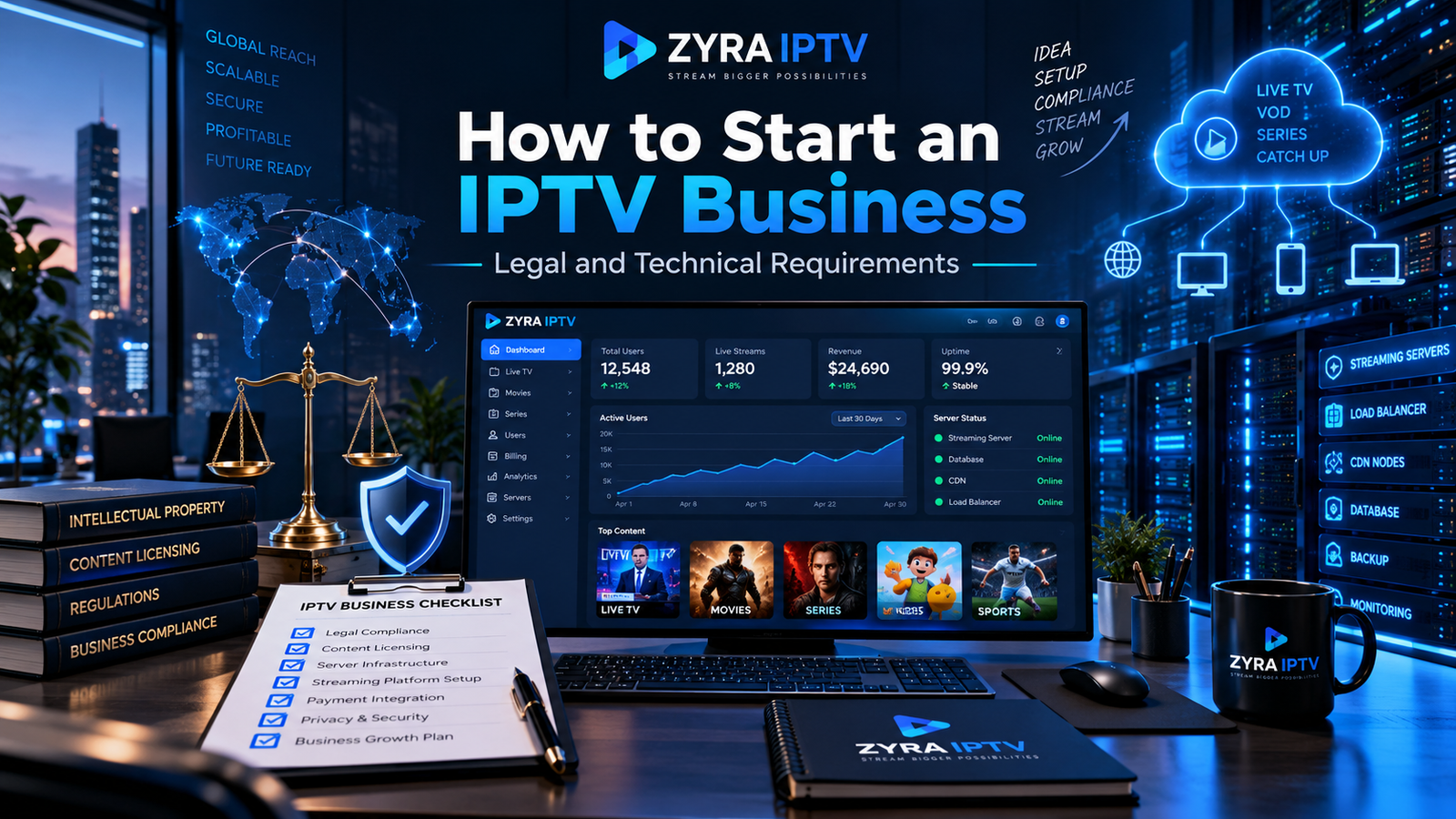
If you want to know how to start IPTV business operations legally, begin with content rights, not servers or reseller software. You need permission to distribute the television channels, movies, sports, or other video you plan to offer, followed by a registered business, a compliant subscription model, streaming infrastructure, customer applications, billing, security, and support.
IPTV technology itself is simply a way to deliver television over IP networks. The major legal risk comes from retransmitting copyrighted programming without the necessary rights.
In the United States, the Copyright Office has explained that internet retransmission of copyrighted television programming generally requires authorization from copyright owners unless an applicable licensing framework applies. Canada likewise recognizes licensing as the mechanism through which copyright owners authorize others to use protected works, while Australian government guidance says copyright material generally requires permission unless an exception or statutory licence applies.
This article covers the legitimate business route rather than unauthorized redistribution.
1. Choose Your IPTV Business Model
Before building the platform, decide exactly what you will sell.
Common legitimate models include:
- subscription live television using licensed channels
- subscription video on demand
- free ad-supported video
- pay-per-view events with distribution rights
- original or commissioned content
- corporate, educational, or hospitality television platforms
- streaming technology for rights holders that already own content
Your model affects licensing, infrastructure, pricing, app development, customer support, and regulatory obligations.
A service carrying live sports has very different rights requirements from a platform distributing its own training videos.
Avoid beginning with an anonymous “reseller panel” that promises large commercial channel packages without documentation showing who owns the distribution rights.
2. Secure Content Rights Before Launching
Content licensing is the most important requirement.
Copyright owners control important uses of their works, including reproduction, communication, public performance, and distribution. In Canada, for example, CIPO explains that copyright owners can license rights and that written agreements can define how protected material may be used.
Your licence agreements should clearly address matters such as:
Territory: Which countries can receive the content?
Term: How long can you distribute it?
Platform: Does the agreement permit IPTV, apps, web streaming, Smart TVs, and mobile devices?
Content: Which specific channels, events, movies, or programmes are covered?
Commercial model: Can you offer subscriptions, advertising, pay-per-view, or bundles?
Concurrent streams: Are there contractual restrictions on simultaneous viewing?
Do not assume that buying access to a consumer television subscription gives you commercial redistribution rights.
3. Register the Business and Define Your Target Market
Once you have a realistic content strategy, establish the business properly in the country where you will operate.
Typical requirements can include:
- company or business registration
- tax registration
- business banking
- accounting
- contracts
- privacy documentation
- consumer terms
- refund and cancellation policies
- payment processing
Requirements differ by jurisdiction.
For example, Australia’s Business Registration Service provides processes for registering an ABN, company, business name, and relevant taxes.
If you plan to operate across Australia, the United States, and Canada, obtain professional advice about the rules that apply where the company is established and where subscribers are located.
4. Check Broadcasting and Streaming Regulations
Copyright is not the only legal consideration.
Depending on the service, country, audience size, and type of programming, additional media regulations may apply.
Australia introduced specific obligations for qualifying subscription video-on-demand services, with the ACMA responsible for administering the current framework. The rules include reporting requirements for certain services and additional Australian-content requirements for major qualifying SVOD providers.
That does not mean every small IPTV business automatically falls into the same regulatory category. It means you should determine your classification before launching rather than assuming that internet delivery avoids television or media regulation.
Country-specific legal advice is particularly important when your service includes live broadcasting, sports, advertising, children’s programming, or subscription billing.
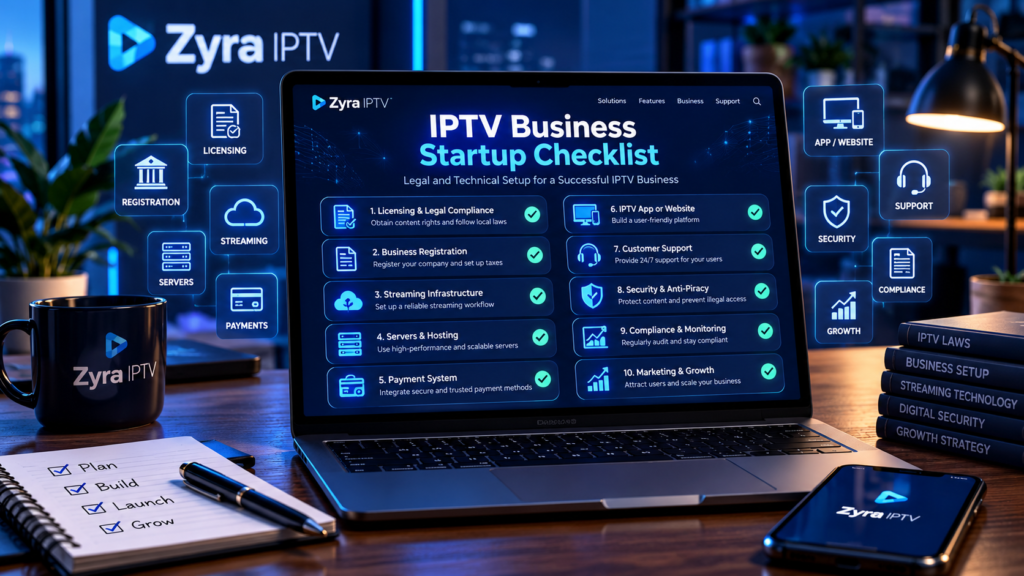
5. Design the IPTV Technical Architecture
After content rights and legal requirements are addressed, you can design the platform.
A typical lawful IPTV system may contain:
| Component | Purpose |
|---|---|
| Content ingest | Receives licensed live or VOD sources |
| Encoder/transcoder | Creates appropriate video renditions |
| Packager | Prepares streams for supported playback formats |
| Origin | Stores or serves master streams |
| CDN | Distributes streams closer to viewers |
| Middleware | Handles users, packages, EPG and entitlements |
| Authentication | Controls authorized subscriber access |
| DRM or encryption | Helps protect licensed content |
| Applications | Provides playback on supported devices |
| Monitoring | Tracks errors and system health |
| Billing system | Manages subscriptions and payments |
Do not build the entire infrastructure around a single server and assume it will scale.
Your design should account for concurrent viewers, bitrate, geographic distribution, storage, redundancy, and peak demand.
6. Choose Streaming Formats and Device Support
Your platform needs video formats that match the devices you plan to support.
Instead of promising compatibility with every television and streaming box, define a tested device list.
You might initially focus on:
- web browsers
- Android TV
- Smart TVs
- mobile devices
- Apple TV
- selected streaming devices
Each additional platform increases development, testing, and customer-support requirements.
Reviewing real end-user workflows can help when planning apps. Zyra’s IPTV installation guides show the kinds of login and installation steps customers may encounter, while its Smart TV setup guidance illustrates television-focused onboarding.
A new service should ideally make activation simpler rather than requiring customers to troubleshoot complicated playlist configurations.
7. Select IPTV Middleware
Middleware connects the customer-facing application to the rest of the service.
Depending on your business model, it may handle:
- subscriber accounts
- authentication
- channel packages
- entitlement rules
- EPG data
- VOD metadata
- subscription status
- device management
- billing integration
- analytics
You can build middleware internally or license a commercial platform.
Before selecting software, confirm who maintains it, how subscriber data is handled, what APIs are available, whether it supports your intended applications, and whether the licence permits your commercial use.
Do not choose a platform solely because it is marketed as an “IPTV panel.”
8. Plan Hosting, CDN and Capacity
Video consumes considerably more network capacity than a normal website.
Calculate expected bandwidth using your average stream bitrate and expected number of simultaneous viewers.
For example, the underlying planning principle is:
Concurrent viewers × average bitrate = approximate streaming throughput
Your real architecture also needs headroom for traffic peaks, multiple renditions, origin traffic, updates, and failures.
A CDN can reduce the load placed directly on your origin and distribute content from infrastructure closer to viewers.
Before launch, test the service under simulated traffic rather than waiting for the first major live event to discover capacity problems.
9. Add Content Protection and Account Security
Rights holders may require technical controls to protect licensed media.
Depending on your agreements, these may include:
- encryption
- DRM
- signed playback URLs
- token-based authentication
- concurrent-session controls
- account security
- access logging
Security should also cover your own systems.
Protect customer credentials, administrative dashboards, payment integrations, APIs, and databases.
Do not store sensitive information simply because it is convenient for development.
10. Build Billing and Subscription Management
A commercial IPTV platform needs more than a payment button.
You should define:
Plans: What does each subscription include?
Renewals: Is billing recurring or one-time?
Cancellation: How does a customer stop renewal?
Refunds: What conditions apply?
Taxes: Which taxes need to be collected?
Invoices: What records will customers receive?
Terms must clearly match what users are charged.
Consumer-protection rules vary between markets. For example, Canada’s Competition Bureau warns against misleading subscription practices and hidden recurring obligations.
Avoid confusing “free trial” offers that hide automatic charges or make cancellation unnecessarily difficult.
11. Test the Full Customer Experience
Before accepting paying customers, test the complete journey:
- Create an account.
- Purchase a plan.
- Receive login information.
- Sign in on each supported device.
- Start live TV or VOD.
- Test EPG and search.
- Test password recovery.
- Cancel or change the subscription.
- Contact customer support.
- Verify billing records.
Also test poor Wi-Fi, slower connections, account expiration, invalid credentials, server failures, and traffic spikes.
Understanding how viewers use different devices is important. The Android TV IPTV guide provides one example of the type of device workflow your own platform should make easy for subscribers.
12. Build Support and Monitoring Before Scaling
IPTV customers may contact support about buffering, login errors, missing EPG information, device compatibility, subscription renewals, or individual streams.
Your monitoring should help distinguish between:
- customer network problems
- app problems
- account problems
- CDN issues
- origin failures
- individual stream failures
- widespread outages
Create internal troubleshooting procedures before your subscriber base grows.
Good monitoring also prevents your support team from telling every customer to reinstall the app when the actual issue is server-side.
Frequently Asked Questions
How to start IPTV business legally?
Start by defining your business model and obtaining written rights for every channel, programme, movie, event, or other copyrighted work you intend to distribute. Then establish the business, build compliant streaming infrastructure, create subscriber applications, and launch only after legal review.
Do I need licences to start an IPTV business?
If you distribute copyrighted television or video owned by others, you generally need appropriate permission or licensing rights unless a specific legal exception applies. The exact rights and regulatory requirements depend on the country and service model.
Can I buy an IPTV reseller panel and start selling?
A technical reseller account does not by itself prove that you have commercial rights to distribute the channels or movies included with it. Verify the underlying content licences before selling access.
Do I need my own servers?
Not necessarily. Infrastructure can be owned, rented, cloud-based, or provided as a managed service. What matters is having sufficient capacity, security, redundancy, and contractual permission for the content you deliver.
What technical components does an IPTV business need?
Most services need content ingest, encoding or transcoding, streaming software, an origin, CDN, subscriber authentication, middleware, applications, billing, monitoring, and appropriate content protection.
Can one IPTV company serve the USA, Canada and Australia?
Technically yes, but distribution rights, consumer rules, privacy requirements, taxes, media regulation, and content licences can differ by country. Your contracts must permit distribution in each territory you serve.
Start With Rights, Then Build the IPTV Platform
The most important lesson in how to start IPTV business operations is to reverse the approach often seen online. Do not begin by buying servers and then look for channels. Begin with a legitimate business model, secure distribution rights, determine your regulatory obligations, and only then build the technical platform required to deliver that content.
A lawful IPTV service combines licensed media, reliable infrastructure, clear billing, secure customer accounts, tested applications, and ongoing technical support.
If you are researching how subscribers interact with IPTV applications and devices before designing your own customer experience, visit Zyra IPTV for practical device and IPTV setup information.