
If you are asking “is IPTV legal in US?”, the short answer is yes, IPTV technology itself is legal in the United States. The legal issue is usually not the technology. It is whether the company transmitting television channels, movies, sports, or other copyrighted content has the necessary authorization to do so.
Licensed television and streaming services can use internet-based delivery lawfully. Problems arise when a provider retransmits copyrighted programming without permission from the copyright owner or another lawful basis.
This distinction is important because the same type of IPTV app or streaming device can potentially be used with either authorized or unauthorized content.
For a broader explanation covering multiple countries, see Zyra IPTV’s general guide to IPTV legality.
What Does US Copyright Law Say About IPTV?
There is no rule in federal copyright law that makes Internet Protocol Television inherently illegal.
Instead, U.S. copyright law protects specific rights held by copyright owners. Under 17 U.S.C. § 106, copyright owners have exclusive rights that include reproduction, distribution, and, for motion pictures and other audiovisual works, public performance.
That matters for IPTV because television programming is transmitted to viewers.
The U.S. Copyright Office has explained that unauthorized streaming can implicate the copyright owner’s public performance right. It has also explained that internet retransmission of television programming generally requires authorization unless an applicable legal licence or exception permits the transmission.
So the key question is not simply “Is this IPTV?” It is “Does this provider have authority to transmit this content to viewers in the United States?”
Legal IPTV vs Illegal IPTV in the United States
The distinction can be summarized simply:
| Situation | General US copyright position |
|---|---|
| IPTV technology | Not inherently illegal |
| Authorized IPTV service | Can lawfully distribute content within the rights it holds |
| Unauthorized retransmission | Can infringe copyright |
| IPTV player or app | Not automatically illegal |
| M3U playlist | Format alone does not establish legality |
| Paid subscription | Payment does not prove that content is licensed |
A professional website, subscription fee, mobile application, or large channel list does not independently establish that distribution rights exist.
Likewise, an inexpensive subscription does not by itself prove infringement. Licensing must be evaluated based on actual authorization, not assumptions about pricing or appearance.
What Is an Illicit Digital Transmission Service?
Federal law specifically addresses certain commercial streaming piracy operations.
18 U.S.C. § 2319C makes it unlawful, under defined circumstances, to willfully offer or provide an illicit digital transmission service to the public for commercial advantage or private financial gain. The statute addresses services designed or marketed primarily for unauthorized digital public performance of copyrighted works.
This provision focuses particularly on people who offer or provide illicit streaming services.
Federal authorities have used copyright and related criminal laws against unauthorized streaming operations. In one IPTV prosecution, the U.S. Department of Justice described operators who obtained cable programming and resold copyrighted content to subscribers without authorization. The lead defendant was later sentenced to prison and ordered to pay substantial restitution and forfeiture.
Federal enforcement remains active. In July 2026, the Department of Justice announced the seizure of more than 1,000 domains that authorities said were streaming FIFA World Cup matches without authorization.
Can You Get in Trouble for Watching Illegal IPTV?
This question needs a more careful answer than many online discussions provide.
The criminal provision in 18 U.S.C. § 2319C specifically addresses people who willfully offer or provide qualifying illicit digital transmission services for commercial advantage or private financial gain. That is not the same conduct as simply opening an IPTV player and watching a stream.
However, that does not mean every form of consumer conduct involving unauthorized content is automatically lawful.
Copyright liability can depend on what a person actually does, including whether content is reproduced, redistributed, publicly performed, downloaded, or shared. The circumstances and technology can matter.
Documented federal IPTV and streaming prosecutions have prominently targeted operators and distributors of unauthorized services.
For an individual situation, especially one involving redistribution or commercial activity, advice from a qualified U.S. copyright attorney is more reliable than Reddit discussions or provider claims.
Is an IPTV App Legal in the USA?
An IPTV app is not automatically illegal.
Many IPTV players are simply pieces of software capable of receiving streams, loading playlists, displaying EPG information, or playing video.
The legal question generally concerns what content is being supplied and whether the relevant transmission is authorized.
For example, the same type of player might be configured with:
- streams supplied by an authorized television service
- personally owned or authorized media
- public streams made available by their rights holders
- unauthorized third-party television streams
The software does not make all of those sources legally equivalent.
Zyra IPTV also provides general IPTV setup and installation information for readers who want to understand how IPTV applications and devices are configured.
Does Paying for IPTV Make It Legal?
No.
Paying for a subscription establishes that there is a commercial transaction. It does not prove that the seller obtained permission from copyright holders.
Federal IPTV cases have involved paid subscription services that authorities alleged or proved were distributing copyrighted programming without authorization.
The reverse is also true. Free internet video is not automatically pirated. Copyright owners can choose to make content available for free, including through advertising-supported services or their own websites.
The relevant question remains authorization.
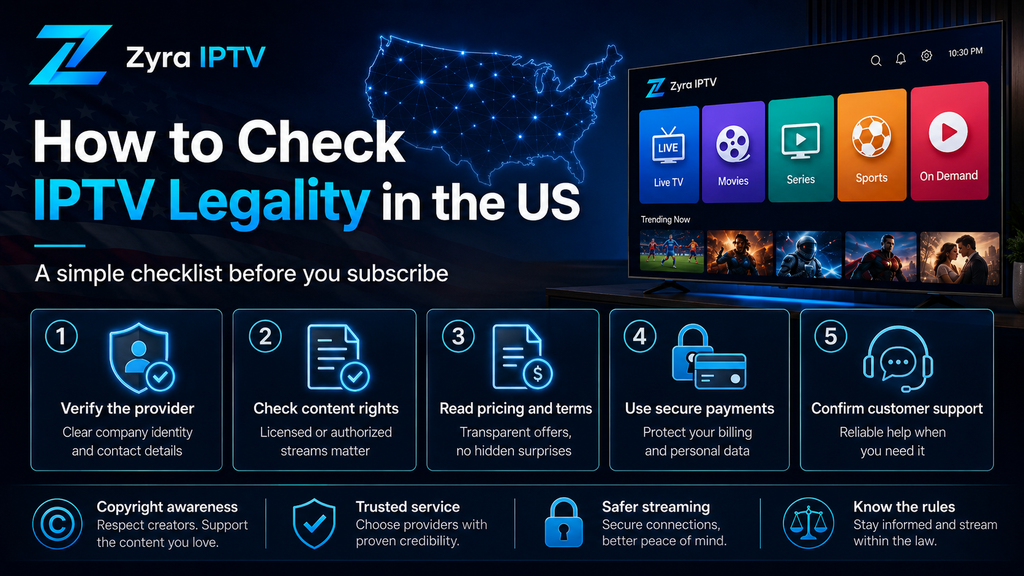
How Can You Check Whether a US IPTV Service Is Legitimate?
Consumers usually cannot inspect private licensing contracts, so there is no single website test that guarantees legality. However, several checks can help.
Look at who actually operates the service, whether meaningful company and contact information is provided, what the terms say about content, whether important distribution claims can be verified, and whether the provider explains regional availability.
Claims involving premium sports can deserve particular attention because live sports streaming is actively protected and enforced. The recent World Cup domain seizures provide a clear example of U.S. authorities acting against alleged unauthorized retransmission.
Do not rely solely on an app-store listing, payment method, website design, customer review, VPN recommendation, or low price when assessing content rights.
Is Guru IPTV Legal in USA?
A service-specific question such as “is Guru IPTV legal in USA?” cannot responsibly be answered solely from the provider’s name or its own marketing claims.
To determine whether a particular service is authorized, you would need reliable evidence showing that it has the necessary U.S. distribution rights for the content it transmits.
The fact that an IPTV provider says it is legal is not independent proof of licensing. Likewise, the absence of publicly visible licensing documents does not by itself establish infringement.
If a specific channel or sports package matters to you, one practical approach is to check whether the relevant broadcaster or rights holder identifies authorized U.S. distribution partners.
Is Indian IPTV Legal in USA?
Yes, Indian television delivered through IPTV can be legal in the United States, provided the service has the appropriate authorization to distribute that programming in the U.S.
The origin of the television channel does not remove U.S. copyright requirements.
A broadcaster may have different distribution arrangements for India, the United States, Canada, and other markets. A service being authorized to distribute content in one country should therefore not automatically be treated as proof that it may retransmit the same content commercially in the United States.
For consumers searching “is Indian IPTV legal in USA?”, the important distinction is between authorized access to Indian programming and an unauthorized reseller retransmitting those channels.
Does Using a VPN Make Illegal IPTV Legal?
No.
A VPN changes how internet traffic is routed. It does not give an IPTV provider copyright permission or create U.S. distribution rights.
If the underlying retransmission is unauthorized, changing the apparent location of an internet connection does not convert that unauthorized transmission into a licensed one.
At the same time, using a VPN does not automatically mean someone is accessing illegal content. VPNs have many ordinary networking and privacy uses.
Frequently Asked Questions
Is IPTV legal in US?
Yes, IPTV technology is legal in the United States. Legal problems arise when copyrighted programming is transmitted or redistributed without required authorization.
Is IPTV illegal in America?
Not by definition. IPTV is a delivery technology. A particular IPTV service may be unlawful if it distributes protected programming without the necessary rights.
Are all paid IPTV services legal?
No. A subscription fee does not establish copyright authorization. Federal cases have involved commercial streaming services that charged subscribers while distributing content without permission.
Is an IPTV player illegal?
Not automatically. An IPTV player is generally software. The source of the content and how it is transmitted are more important legal questions.
Is watching foreign IPTV legal in the US?
Foreign television can be distributed legally in the United States when the provider has the appropriate rights. A provider should not be assumed to have U.S. rights merely because the programming is authorized in another country.
Understanding IPTV Legality in the United States
The answer to “is IPTV legal in US?” comes down to separating the technology from the content.
IPTV itself is simply a method of delivering television over IP-based networks. U.S. copyright law becomes relevant when protected television, sports, movies, or other audiovisual works are transmitted without the required authorization. Copyright owners have exclusive rights that include public performance, and federal law also specifically targets qualifying commercial illicit digital transmission services.
Before subscribing to any IPTV service, look beyond the IPTV label. Consider who operates the service, what content it provides, whether important distribution claims can be verified, and whether its terms are transparent.
If you want to review the service information and available resources before making a decision, visit Zyra IPTV and evaluate the offering according to your own requirements and applicable U.S. rules.