
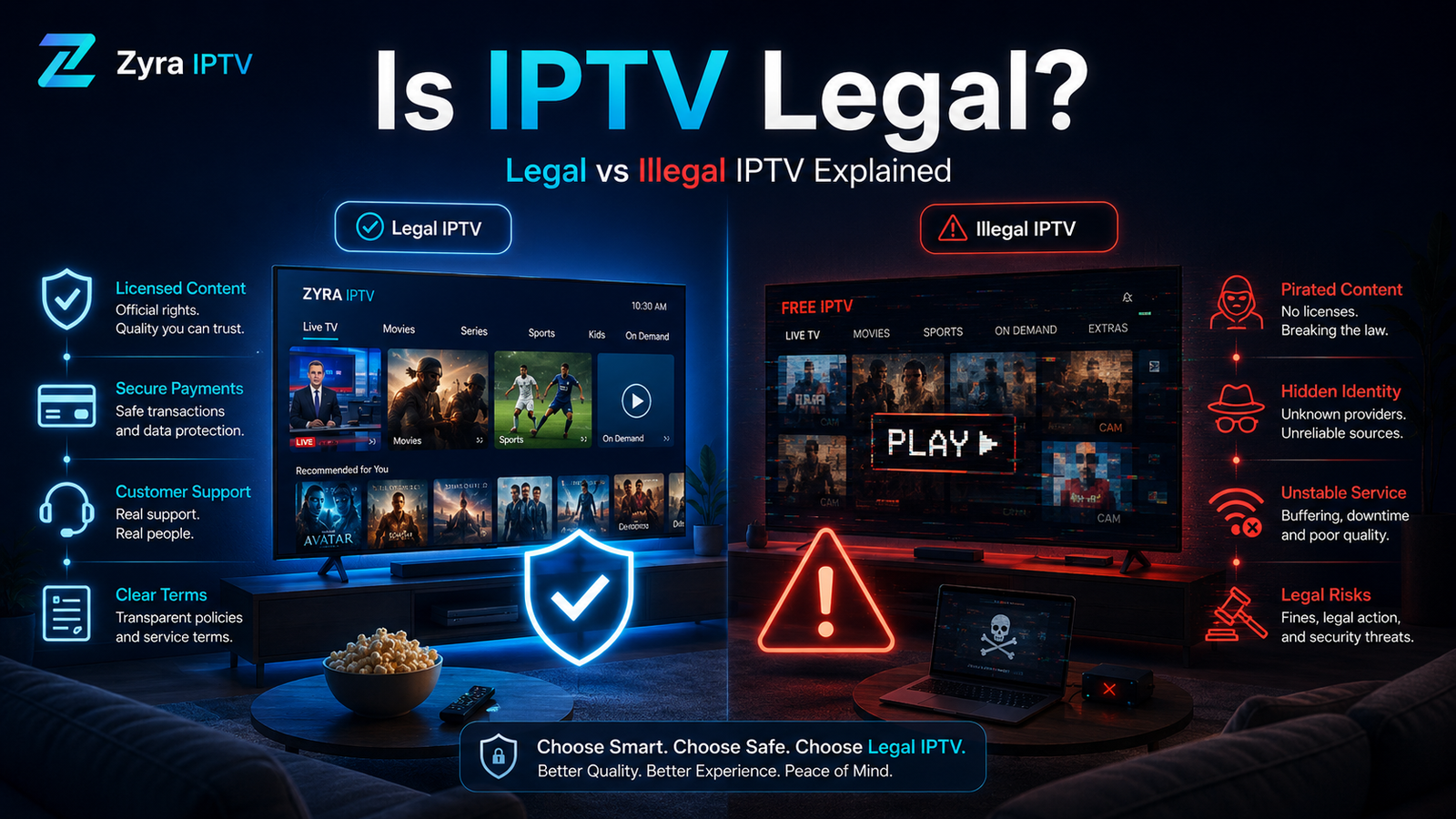
Is IPTV legal? Yes, IPTV technology itself is legal. The legal issue is not the technology used to deliver television, but whether the provider has permission or appropriate rights to distribute the channels, movies, sports, and other content it offers.
Legitimate broadcasters, telecommunications companies, and streaming platforms can all use Internet Protocol technology to deliver television. Problems arise when a service retransmits copyrighted content without authorization from the relevant rights holders.
Because copyright rules differ by jurisdiction, the legal position of a particular service or user cannot be determined from the word “IPTV” alone. This guide explains the distinction and highlights important differences for viewers in Australia, the United States, and Canada.
If you are new to the technology, the Zyra IPTV guide explaining what IPTV is provides a useful introduction.
What Makes an IPTV Service Legal or Illegal?
IPTV stands for Internet Protocol Television. It describes a method of delivering television through IP-based networks.
The technology itself does not determine whether a service is lawful.
The central question is usually content authorization.
A provider may need permission or licences from broadcasters, studios, sports organizations, networks, distributors, or other copyright owners before making protected programming available to subscribers.
A simple comparison is:
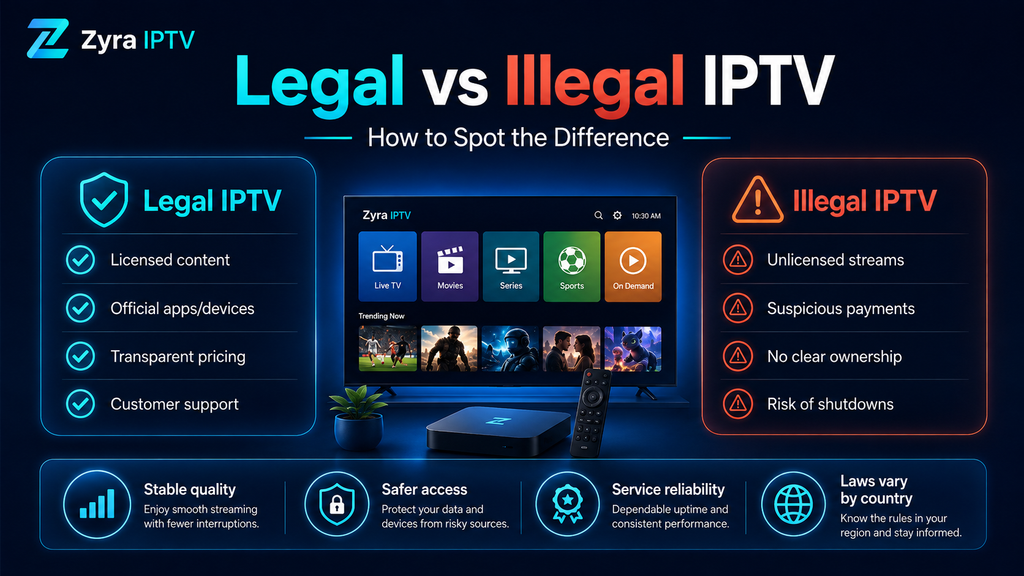
| Legal IPTV | Potentially illegal IPTV |
|---|---|
| Distributes content with appropriate authorization | Distributes copyrighted content without required permission |
| Provides content it has the right to offer | Retransmits channels, movies, or sports without distribution rights |
| Operates subject to applicable copyright and broadcasting rules | Relies on unauthorized copies or streams |
| Makes its service terms and business information reasonably clear | May provide little information about where content rights come from |
A low price, unusual payment method, or large channel lineup does not by itself prove that an IPTV service is illegal. Licensing arrangements are not always visible to consumers, so legality should be assessed using reliable evidence rather than assumptions.
Why Copyright Licensing Matters
Television programs, films, sporting broadcasts, and other media are commonly protected by copyright.
Copyright owners generally control specific uses of their material, including reproduction, communication, distribution, or public performance depending on the jurisdiction.
In Australia, the Attorney-General’s Department explains that copyright owners have exclusive rights that include copying, communicating, and publicly performing protected material. Using a protected work in a way reserved for the copyright owner without permission can amount to infringement unless an exception applies.
The same basic principle appears in the United States and Canada, although the exact laws, remedies, offences, and exceptions differ.
This is why asking “are IPTV services legal?” requires looking at the service’s content rights, not simply whether it streams over the internet.
Is IPTV Legal in Australia?
IPTV technology is not inherently illegal in Australia.
Australian copyright law protects material including films and television broadcasts. The Australian Attorney-General’s Department states that copyright infringement generally occurs when someone performs an act reserved to the copyright owner without permission, subject to statutory exceptions.
Therefore, an IPTV platform that has the necessary rights to distribute its programming can operate lawfully from a copyright perspective. A service that retransmits protected programming without authorization may raise copyright infringement issues.
Australia also has mechanisms directed at online copyright infringement, so consumers should not assume that the internet-based nature of a service removes normal copyright requirements.
For a specific service or situation, legal advice from an Australian professional may be necessary.
Is IPTV Legal in the United States?
IPTV technology is also legal in the United States, but unauthorized streaming can violate federal copyright law.
The U.S. Copyright Office has stated that unauthorized streaming can implicate a copyright owner’s public performance right.
Federal authorities have also prosecuted operators of unauthorized streaming and IPTV services. In one IPTV case, the U.S. Department of Justice described a scheme in which operators allegedly obtained television programming and resold copyrighted content to subscribers without authorization.
More recently, the Department of Justice seized hundreds of domains that it said were streaming 2026 FIFA World Cup matches without authorization.
These enforcement examples mainly concern providers, operators, and unauthorized distribution. They should not be interpreted as meaning that every person using an IPTV application automatically commits the same offence.
The legal consequences for an individual viewer depend on the person’s conduct, the applicable law, and the facts of the case.
Is IPTV Legal in Canada?
Canada follows the same broad distinction between IPTV technology and unauthorized use of copyrighted content.
The Canadian Intellectual Property Office explains that copyright infringement can occur when protected content is used in a manner that violates rights granted under the Copyright Act, such as copying or communicating protected material without authorization. It also emphasizes that only a court can ultimately determine whether infringement has occurred in a particular case.
There is another important Canadian distinction.
The Canadian Radio-television and Telecommunications Commission explains that services streaming content over the internet do not need a conventional CRTC broadcasting licence simply because they operate online. However, whether content may be made available still depends on distribution rights.
In other words, not needing a particular CRTC licence does not mean a provider automatically has copyright permission for every channel or program it offers.
Is an IPTV App Legal?
Usually, the existence of an IPTV app or player is not what determines legality.
An IPTV player can simply be software that receives and displays streams. The same application might be used with authorized content in one situation and unauthorized content in another.
For example, an app may support:
- M3U playlists
- live TV streams
- EPG data
- account credentials
- video-on-demand playback
Those technical capabilities do not prove whether the content itself is licensed.
The better question is not simply “is this IPTV app legal?” but “does the service or content loaded into this app have the required rights?”
An app being available through a well-known app store also should not be treated as conclusive evidence about the licensing status of every third-party stream that can be loaded into it.
For a deeper explanation of the delivery process, see Zyra IPTV’s guide to how IPTV works.
How Can You Assess Whether an IPTV Service Is Legitimate?
Consumers often cannot inspect private licensing contracts, but there are still practical questions worth asking:
- Does the provider clearly identify the company or organization operating the service?
- Are its terms, contact information, and policies reasonably transparent?
- Does it explain where and in which regions particular programming is available?
- Can important channel or sports rights be verified through official broadcasters or rights holders?
- Is the provider making unrealistic claims about having every premium service or event everywhere?
- Does it tell users to circumvent access controls or geographic restrictions in order to obtain content they would not otherwise be entitled to access?
None of these factors alone provides a definitive legal test. They are simply reasons to investigate further.
When rights are unclear, verify information with the relevant broadcaster, copyright owner, regulator, or qualified legal professional.
Does Using a VPN Make IPTV Legal?
No.
A VPN changes how internet traffic is routed and may provide privacy or networking functions, but it does not create copyright licences or distribution rights.
If a service does not have permission to distribute particular content, connecting through a VPN does not change the provider’s underlying authorization.
Likewise, a service requiring or recommending a VPN does not automatically prove that it is illegal. Legality still depends on the actual service, content rights, conduct, and applicable law.
Can You Get in Trouble for Using Illegal IPTV?
There is no universal answer because laws and enforcement practices vary between countries.
Operators who intentionally distribute copyrighted material without authorization can face serious civil or criminal consequences in some circumstances. U.S. cases, for example, show that authorities have pursued commercial operators of unauthorized streaming services.
The position of an individual viewer can be more complicated.
Factors may include what the user actually did, whether content was copied or redistributed, the applicable copyright statute, knowledge or intent requirements, and whether civil or criminal provisions apply.
Canada’s government guidance, for example, explains that its Notice and Notice regime allows copyright owners to send allegations of online infringement through internet service providers, while also emphasizing that a notice is not itself a court judgment that infringement occurred.
For that reason, claims such as “viewers can never face consequences” or “everyone who watches an unauthorized IPTV stream will be prosecuted” are both too broad.
Frequently Asked Questions
Is IPTV illegal?
No. IPTV itself is simply a television delivery technology. A particular IPTV service may create legal issues when it distributes protected content without the necessary authorization.
Are all paid IPTV services legal?
No. Charging a subscription fee does not prove that a provider has distribution rights. Free services are not automatically illegal either. Content authorization is the important factor.
What is IPTV and is it legal?
IPTV is television delivered using Internet Protocol technology. The technology is legal, while the legality of a particular service depends on issues such as licensing, copyright permissions, and local law.
Can an IPTV player be illegal?
A player is generally just software. Legal questions normally depend more on what content is being accessed, how it was obtained, and whether the relevant rights exist.
Are IPTV laws the same in every country?
No. Copyright law, enforcement procedures, broadcasting regulation, exceptions, and remedies differ between jurisdictions. Australia, the United States, and Canada should not be treated as having identical IPTV rules.
Legal IPTV Comes Down to Rights, Not the Technology
So, is IPTV legal? The technology itself is legal. The important distinction is whether the television service has the necessary authorization to distribute the content it provides.
For viewers, the safest approach is to avoid assuming that price, an app, a website, or the term IPTV proves anything about licensing. Check who operates the service, review its terms, investigate content rights where possible, and follow the laws that apply where you live.
If you are evaluating Zyra IPTV, you can review its service information alongside these licensing and transparency checks before deciding whether it meets your requirements.