
If you are wondering “is IPTV illegal in Australia?”, the short answer is no, IPTV technology itself is not illegal. IPTV simply delivers television and video using Internet Protocol technology.
The legal issue is the content being distributed. If an IPTV provider has permission or appropriate rights to supply its channels, movies, sports, and other programming in Australia, using internet technology to deliver that content does not make the service illegal. Problems can arise when copyrighted material is distributed without authorization.
Australian copyright law therefore matters more than the IPTV label itself.
This article explains the general Australian position and is intended as informational guidance, not individual legal advice.
Is IPTV Legal in Australia?
Yes, IPTV can be legal in Australia.
IPTV stands for Internet Protocol Television. It is a technical method of delivering television through an IP-based network rather than relying solely on terrestrial broadcasting, satellite, or traditional cable infrastructure.
If you want the technical background first, Zyra IPTV’s beginner guide to what IPTV is explains how IPTV technology works.
Australia’s Copyright Act 1968 protects material including films and television broadcasts. The Australian Attorney-General’s Department explains that copyright owners have exclusive economic rights that can include copying, publishing, communicating, and publicly performing protected material.
The important question is therefore not simply:
“Is this IPTV?”
It is:
“Does the service have the necessary rights to distribute this content in Australia?”
When Can IPTV Become Illegal in Australia?
IPTV becomes legally problematic when protected content is used or distributed in ways reserved for the copyright owner without permission and no relevant exception applies.
The Attorney-General’s Department states that copyright is generally infringed when someone performs one of the exclusive acts belonging to the copyright owner without permission. Australian law also recognises specific exceptions and statutory licences, so the circumstances matter.
For an IPTV provider, potential concerns could include unauthorized retransmission of:
- television channels
- movies
- TV series
- live sporting broadcasts
- pay-per-view events
- other protected video content
The current Copyright Act provides that copyright may be infringed when someone without the copyright owner’s licence does, or authorizes, an act comprised in that copyright.
This is why an IPTV service can look technically similar to another service while having a completely different legal position.
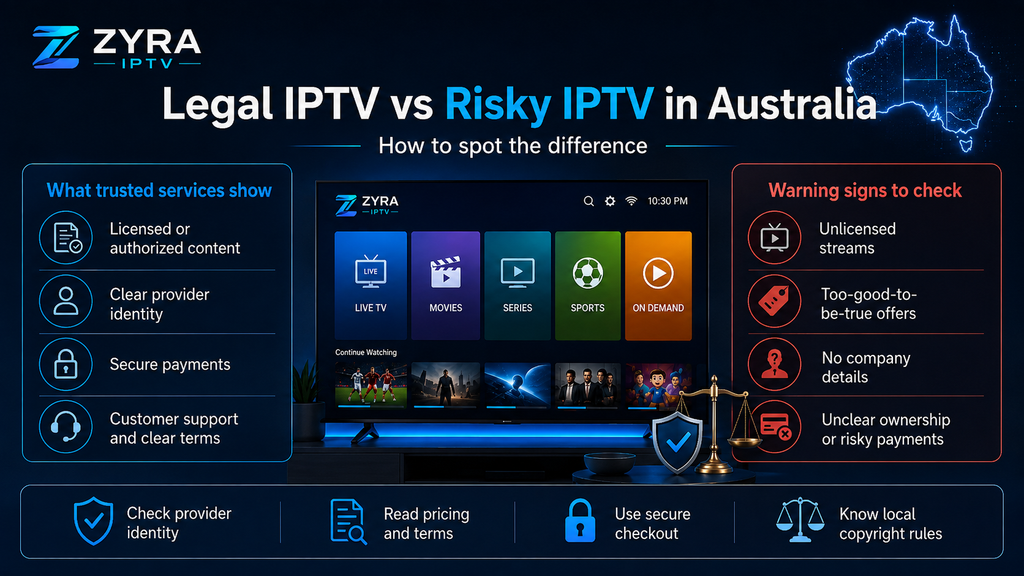
Legal IPTV vs Unauthorized IPTV
The basic distinction can be summarized like this:
| IPTV situation | General Australian copyright position |
|---|---|
| IPTV technology | Not inherently prohibited |
| Provider authorized to distribute its content | Can operate lawfully from a copyright perspective |
| Unauthorized retransmission of protected content | Can raise copyright infringement issues |
| IPTV application or player | Not automatically illegal |
| M3U playlist | Format alone does not determine legality |
| Paid IPTV subscription | Payment does not prove licensing |
| Free IPTV stream | Free access does not automatically prove infringement |
A service should therefore be evaluated according to its authorization and conduct rather than simply its price, app, website design, or use of the term IPTV.
For a broader comparison of lawful and unlawful IPTV concepts, see Zyra IPTV’s guide to legal and illegal IPTV.
How Does Australian Copyright Law Apply to IPTV?
Copyright is particularly relevant to IPTV because television delivery involves protected audiovisual material.
The Attorney-General’s Department states that Australian copyright owners may control acts including communicating their material to the public, which includes making material available online or electronically transmitting it to the public.
The Copyright Act also protects television broadcasts and other audiovisual subject matter. Unauthorized acts involving protected broadcasts can therefore raise infringement issues independently of the technology used to deliver them.
An internet connection does not create an exception to those rights.
For example, moving a television stream from a satellite or broadcaster feed onto an internet server does not automatically give the operator permission to sell access to that stream.
Can Australian Authorities Block Illegal IPTV Websites?
Australian law includes a specific mechanism for restricting access to certain overseas online locations associated with copyright infringement.
Under section 115A of the Copyright Act 1968, a copyright owner can apply to the Federal Court of Australia for an injunction requiring a carriage service provider to take reasonable steps to disable access to an online location outside Australia when the statutory requirements are satisfied.
The provision applies where the location infringes or facilitates copyright infringement and has the primary purpose or primary effect of infringing or facilitating infringement. Search engines can also be covered by orders requiring them not to provide certain search results.
This is commonly described as Australia’s site-blocking framework.
Importantly, a blocked streaming website does not mean IPTV technology as a whole has been outlawed. The legal action concerns particular online locations and alleged or established copyright infringement.
Can IPTV Providers Face Penalties in Australia?
Potentially, yes.
Australian copyright law provides civil remedies for infringement and also contains criminal offences for certain copyright-related conduct. Some offences specifically relate to commercial dealings in infringing material, public use, distribution, or obtaining commercial advantage.
The consequences depend heavily on the specific conduct involved.
It is therefore inaccurate to say that every questionable IPTV service creates the same legal exposure. An operator intentionally redistributing protected television commercially is in a different position from someone who merely has an IPTV player installed on a television.
Can Viewers Get in Trouble for Using Illegal IPTV?
This question is more complicated than many online answers suggest.
The fact that a provider may be infringing copyright does not automatically mean every subscriber has committed the same infringement or offence. Australian copyright liability depends on the acts performed, the person’s role, the technology involved, authorization, applicable exceptions, and other facts.
At the same time, it would be unsafe to conclude that viewers can never face legal consequences in any situation.
Activities such as copying, redistributing, reselling, communicating streams to others, or using protected material commercially can raise different legal issues from ordinary private viewing. Australian copyright law also contains separate rules covering civil infringement and criminal conduct.
Anyone facing an actual copyright allegation should obtain advice from an Australian lawyer rather than relying on general online guidance.
Is an IPTV App Illegal in Australia?
No, an IPTV player or app is not automatically illegal simply because it supports IPTV.
A player may only provide software functions such as:
- playing live streams
- loading an M3U playlist
- displaying an EPG
- organizing channels
- receiving login credentials
- playing video-on-demand content
The same player could potentially be used with authorized content or with an unauthorized source.
Installing an application therefore does not, by itself, answer the copyright question. The source of the content and the rights behind its distribution are more important.
Does Paying for IPTV Prove It Is Legal?
No.
A subscription fee proves that money is being charged. It does not independently establish that the provider has permission from broadcasters, studios, sporting organizations, or other rights holders.
Likewise, a low price does not automatically prove illegality.
Consumers usually cannot see private licensing contracts, so price should be treated as one piece of context rather than a legal test.
A better approach is to investigate the service itself.
How to Check an IPTV Service Before Subscribing
Before paying for an IPTV subscription in Australia, consider several questions:
- Who operates the service? Look for meaningful business and contact information.
- Are the terms clear? Review subscription, cancellation, and refund conditions.
- Are its content claims realistic? Be cautious about extraordinary claims involving premium channels and sporting rights across many countries.
- Can important rights claims be verified? Check official broadcasters or rights holders when a particular service claims a formal relationship.
- Does the provider explain geographic availability? Television and sporting rights can be territorial.
- Does it make unsupported legality claims? A statement saying “100% legal” is not the same as independent evidence of authorization.
- Is it transparent about what it actually provides? Vague or contradictory information deserves further investigation.
None of these checks alone can conclusively establish copyright licensing, but together they can help consumers make a more informed decision.
Does a VPN Make Illegal IPTV Legal in Australia?
No.
A VPN can change how internet traffic is routed, but it cannot create copyright permission or distribution rights.
If an IPTV provider is not authorized to distribute particular programming in Australia, connecting through a VPN does not give that provider the missing licence.
VPN use itself also does not prove that an IPTV service is illegal. VPNs have many legitimate privacy, networking, and security uses.
The copyright status of the underlying content remains the important issue.
What About IPTV in Pubs, Restaurants, and Businesses?
Commercial viewing can involve additional considerations.
A subscription intended for personal or household use should not automatically be assumed to permit displaying television, movies, or sports to customers in a commercial premises.
Australian copyright owners have rights that can include public performance and communication to the public. Businesses should therefore check both content licences and the terms of their subscriptions before using television programming commercially.
Frequently Asked Questions
Is IPTV illegal in Australia?
No. IPTV technology itself is not inherently illegal in Australia. Copyright problems can arise when protected television, movies, sports, or other content is distributed without appropriate authorization.
Is IPTV legal in Australia?
Yes, IPTV can be legal when the provider is authorized to distribute the content it offers and complies with applicable Australian law.
Are all paid IPTV subscriptions legal?
No. Charging customers does not prove that the provider holds the required content rights.
Are IPTV apps illegal in Australia?
Not automatically. An IPTV app is generally software used to receive or organize streams. The legality of the content and its distribution must be considered separately.
Can Australia block illegal IPTV sites?
Australian copyright owners can apply to the Federal Court for qualifying site-blocking injunctions under section 115A of the Copyright Act.
Does a VPN make IPTV legal?
No. A VPN does not grant copyright licences or turn unauthorized distribution into authorized distribution.
Understanding IPTV Legality in Australia
So, is IPTV illegal in Australia? Not simply because it uses IPTV technology.
The main legal distinction is between authorized delivery and unauthorized use or distribution of copyrighted material. Australia’s Copyright Act protects films, television broadcasts, and other creative material, gives rights holders control over important uses of that content, and provides mechanisms including civil enforcement and qualifying site-blocking injunctions.
Consumers should therefore investigate the provider, content rights, terms, and regional availability rather than assuming that every IPTV service has the same legal status.
If you are considering an IPTV service, you can review Zyra IPTV and its published information alongside these Australian copyright and licensing considerations before deciding whether it meets your requirements.