
Is IPTV Safe to Use? Security and Privacy Risks Explained
Is IPTV safe to use? IPTV as a television delivery technology is not inherently dangerous, but the safety of your experience depends on the provider, the app you install, where you download it from, what permissions it requests, and how you handle account and payment information. The biggest concerns are usually not the video stream itself. They include malicious or modified apps, phishing, weak account security, excessive app permissions, questionable payment pages, and providers that are unclear about how they handle personal information. You can reduce many of these risks by using trusted software sources, keeping devices updated, reviewing app permissions, and checking a provider carefully before entering payment or login information. What Makes IPTV Safe or Unsafe? IPTV stands for Internet Protocol Television. It delivers television and video through IP-based networks instead of relying only on traditional cable, satellite, or terrestrial broadcasting. The technology itself does not tell you whether a particular service is trustworthy. Think of IPTV safety as several separate questions: Safety area What to consider App security Where the IPTV player came from and whether it may contain harmful software Privacy What data the app or provider collects and which device permissions are requested Account security How passwords and login credentials are handled Payment safety Whether the checkout process and payment recipient are trustworthy Provider reliability Whether the company clearly identifies itself and publishes meaningful terms Network security Whether your device and home network are properly protected A service can perform well technically while still having weak privacy practices, so streaming quality should not be treated as proof of security. Can IPTV Apps Contain Malware? Yes, a malicious application disguised as an IPTV player can potentially contain malware. This risk is especially relevant when users download unofficial APK files, modified applications, browser extensions, or add-ons from unfamiliar websites. The U.S. Federal Trade Commission has specifically warned that malicious software has been distributed through apps and add-ons associated with pirated video streaming. Such malware can potentially expose login details, financial information, or other data stored on devices connected to a network. That does not mean every third-party IPTV application is malicious. It means the source of the software matters. A safer approach is to: Google Play Protect, for example, checks Android apps for potentially harmful behaviour and can scan apps installed from sources outside Google Play as well. If you need help understanding normal installation procedures, review the IPTV installation guides before installing unfamiliar software. Is Sideloading an IPTV App Dangerous? Sideloading means installing software outside the device’s normal application store. Sideloading is not automatically malicious, but it removes some of the safeguards associated with downloading through an official marketplace. The risk depends heavily on the source and integrity of the file. Be cautious when an installation guide asks you to: Android users should keep Google Play Protect enabled unless they have a specific and well-understood reason not to. Google states that Play Protect can warn about, deactivate, or remove potentially harmful applications. For platform-specific setup information, you can also review the Android TV IPTV guide. What Privacy Risks Can IPTV Apps Create? Privacy risks depend on the individual app and service. An IPTV application may legitimately require internet access and account credentials, but permissions unrelated to its normal function deserve closer attention. For example, ask why a television streaming app would need broad access to: A permission request does not automatically prove malicious intent, but the developer should have a reasonable explanation for why it is needed. On iPhone and iPad, Apple allows users to review access to data such as contacts, photos, location, camera, and microphone. Apple’s App Privacy Report can also show app network activity and how frequently apps access certain sensitive information. Android users can similarly review permissions in device settings. Before using an IPTV application, read its privacy policy when available and avoid granting permissions that do not appear necessary for streaming. Can Your IPTV Login Details Be Stolen? Any online account can become vulnerable if credentials are exposed through phishing, malware, or poor password practices. IPTV login details might include a username, password, playlist URL, portal address, or another form of account access. To protect them: The FTC warns that phishing messages often impersonate companies and claim that an account or payment method has a problem in order to persuade users to reveal sensitive information. When in doubt, access the provider through the website you normally use rather than following an unexpected message link. Is It Safe to Pay for an IPTV Subscription Online? It depends on the provider and payment process. Before entering card or financial information, check: Do not assume a service is trustworthy simply because it accepts a particular payment method. Likewise, unusual payment methods do not automatically prove fraud. The key issue is whether you understand who you are paying and what protections may be available if the transaction goes wrong. Be especially careful if someone contacts you unexpectedly and asks you to change payment details or send money to a new recipient. Does IPTV Put Your Home Network at Risk? An ordinary video stream does not automatically compromise your Wi-Fi network. The greater concern is software running on a device connected to that network. If an application contains malware, the affected device may potentially expose data or create risks for other connected systems. The FTC has warned that malware associated with illicit streaming apps can potentially spread risk beyond the original streaming device to other devices on the same wireless network. Basic network hygiene helps: Your Smart TV or streaming box is still a network-connected computer, so it should be treated accordingly. For television-specific installation guidance, see the Smart TV IPTV setup guide. Does a VPN Make IPTV Safe? A VPN can encrypt traffic between your device and the VPN server, but it does not solve every IPTV security problem. A VPN cannot automatically protect you from: It also does not prove that an IPTV service is legitimate. A VPN should therefore be viewed as
Is IPTV Canada Legit? How to Check an IPTV Service Before Subscribing
If you are asking “is IPTV Canada legit?”, there is no single yes or no answer that applies to every IPTV provider operating in or marketing to Canada. IPTV itself is legitimate technology. The important questions are whether the company taking your money is genuine, whether its subscription terms are transparent, and whether it has appropriate authorization for the television channels, movies, sports, and other copyrighted content it distributes. That means checking an IPTV service requires more than looking at its website design, price, channel list, or reviews. Canadian consumers should consider both business legitimacy and content legitimacy before subscribing. What Does “Legit IPTV” Mean? People often use “legit” and “legal” interchangeably, but separating them makes evaluating a service easier. A provider can raise several different questions: Question What you are checking Is the business genuine? Identity, company details, contact information Is the subscription transparent? Price, duration, renewal, cancellation, refunds Is the content authorized? Rights to distribute channels, films, sports, and other programming Is payment reasonably protected? Payment recipient, transaction records, dispute options Are claims believable? Performance, content availability, device support, legal claims For the copyright side specifically, Zyra IPTV’s guide to legal and illegal IPTV explains why IPTV technology and content authorization are separate issues. 1. Check Who Actually Operates the IPTV Service Start with the company behind the website. A provider should ideally make it reasonably clear who customers are dealing with. Look for: A professional-looking website alone does not prove legitimacy. If a provider specifically claims to be a Canadian corporation, you can investigate that statement. The Government of Canada provides access to Canadian business registries and a federal corporation search. However, a company not appearing in the federal database is not automatically suspicious because businesses can also be incorporated provincially or territorially. Treat registration information as one verification signal, not a complete test. 2. Separate Business Legitimacy From Content Rights This is one of the most important checks. A real business can still face questions about whether it has permission to distribute particular programming. Canadian copyright protection covers rights including reproduction and communication of protected works to the public. The Canadian Intellectual Property Office explains that infringement can occur when copyrighted content is copied or communicated to the public without the copyright owner’s authorization. Therefore, a paid IPTV subscription is not automatically legitimate merely because: The provider must also have whatever rights are required for the content it distributes. This becomes especially relevant with premium television channels, live sports, movies, and international programming because distribution rights may differ by country. 3. Examine the Channel and Content Claims Before subscribing, examine what the provider says it offers. You can use a published IPTV channel list to understand the claimed programming, but a list of channel names should not automatically be treated as proof that distribution rights exist. Pay additional attention when a provider claims to offer an unusually broad collection of premium programming from many different regions. Useful questions include: A huge content library is neither proof of legitimacy nor proof of illegitimacy. It is simply something worth investigating. 4. Read the Subscription and Refund Terms Do not subscribe until you understand exactly what you are purchasing. Check: Hidden or difficult-to-find conditions are a warning sign for any online purchase, not only IPTV. Canada’s Competition Bureau advises online shoppers to examine terms and conditions, check vendor feedback, be cautious about offers that seem too good to be true, and pay attention to the website they are using. Keep a copy of the terms that applied when you purchased your subscription. 5. Check How the Provider Wants You to Pay Payment method alone cannot tell you is IPTV legitimate, but it can affect your ability to resolve a dispute. Consider: The Competition Bureau has advised Canadian consumers that credit cards can provide useful protections in some online shopping situations. That does not mean credit card acceptance proves an IPTV service is legitimate. It simply means payment protections are one factor to consider. 6. Test Customer Support Before Committing Contacting support before purchasing can reveal useful information about how the business operates. Instead of asking only “Does it work?”, ask a specific question. For example: Compare the answer with the information published on the website. Be cautious if support repeatedly avoids straightforward questions, changes important conditions during the conversation, or creates artificial pressure to pay. If you need to understand normal installation terminology before speaking with a provider, Zyra IPTV’s IPTV setup guides can help clarify how device setup and IPTV applications generally work. 7. Do Not Rely on Reviews Alone Reviews can be useful, but they are not proof. Search results for terms such as is IPTV legit often contain: Look for patterns instead of focusing on one glowing or negative review. A more useful review describes specific experiences, such as billing, support, cancellation, installation, or service interruptions. Generic statements such as “best IPTV ever” provide much less evidence. Also consider whether the reviewer has a financial relationship with the service. Independent reviews can help you identify questions to investigate, but they cannot confirm private licensing agreements. 8. Understand What CRTC Registration Means Some Canadian consumers assume that every legitimate streaming provider must appear in a CRTC database. The situation is more complicated. The CRTC’s online streaming framework includes registration requirements for qualifying online undertakings. Current rules generally exempt undertakings or ownership groups with less than $10 million in annual Canadian broadcasting revenues, alongside certain other exemptions. Therefore: No CRTC registration does not automatically mean an IPTV service is illegal. The opposite is also important: CRTC registration does not automatically prove that every channel or movie offered by a provider is properly licensed. Broadcasting regulation and copyright authorization are separate questions. 9. Be Skeptical of Absolute Claims Legitimate businesses should be able to explain their services without relying on claims that cannot reasonably be guaranteed. Be cautious with statements such as: Streaming performance can depend on internet connectivity, Wi-Fi conditions, device performance, software, network congestion, and the
Is IPTV Legal in Canada? Canadian IPTV Laws Explained
If you are asking “is IPTV legal in Canada?”, the short answer is yes, IPTV technology itself is not illegal in Canada. The important legal question is whether a particular provider has the necessary authorization to distribute the television channels, movies, sports, and other copyrighted content it offers. Internet Protocol Television is simply a method of delivering television through IP-based networks. The technology can support legitimate television services as well as unauthorized streaming operations. Canadian copyright law, CRTC broadcasting rules, and court enforcement all affect the broader legal picture. This guide explains those distinctions in practical terms. It provides general information and is not legal advice. Why IPTV Itself Is Not Illegal in Canada IPTV stands for Internet Protocol Television. Instead of receiving television only through satellite, cable, or terrestrial broadcasting, IPTV uses IP-based networks to deliver video to viewers. The delivery technology does not determine whether the content is authorized. If you are unfamiliar with the technical side, Zyra IPTV’s beginner guide to what IPTV is explains IPTV, streaming, players, live TV, and video-on-demand in more detail. A legal issue can arise when copyrighted programming is supplied without the permission required under Canadian law. Canada’s Copyright Act gives copyright owners several exclusive rights, including the right to communicate protected works to the public by telecommunication. The Act also recognizes making content available so that members of the public can access it individually as communication to the public by telecommunication. What Makes an IPTV Service Legal or Illegal? The main distinction is authorization to distribute the content. An IPTV provider may offer television programmes, films, sporting events, or other media only within whatever rights it has obtained. Distribution rights can also be territorial, meaning permission relating to another country does not necessarily establish permission for Canada. The Canadian Intellectual Property Office explains that copyright infringement can occur when protected content is used in a way that violates rights granted by the Copyright Act, such as copying or communicating a work to the public without the copyright owner’s authorization. It also notes that only a court can ultimately determine whether infringement occurred in a particular case. IPTV situation General Canadian position IPTV technology Not inherently illegal Authorized television distribution Can operate lawfully, subject to applicable rules Unauthorized copyrighted streams May constitute copyright infringement IPTV player or app Not automatically illegal M3U playlist Format alone does not determine legality Paid subscription Payment does not prove authorization This is why neither the word “IPTV” nor a subscription fee tells you whether a service is lawful. Does the CRTC Regulate IPTV in Canada? The Canadian Radio-television and Telecommunications Commission, or CRTC, regulates broadcasting in Canada, including aspects of online streaming. Under Canada’s modernized broadcasting framework, certain online streaming services that operate in Canada, provide broadcasting content, and meet the applicable revenue threshold must register with the CRTC. The CRTC currently states that registration generally applies when an online streaming service, alone or as part of a broadcasting ownership group, earns at least $10 million in annual Canadian broadcasting revenues, subject to applicable exemptions. However, CRTC registration and copyright authorization are different matters. A service being registered with the CRTC does not automatically prove that it has distribution rights for every channel, movie, or sporting event it carries. Likewise, a service that falls below the CRTC registration threshold is not automatically illegal. For IPTV legality, broadcasting regulation and copyright licensing need to be considered separately. Is Unlicensed IPTV Illegal in Canada? An IPTV service can face copyright problems when it distributes protected programming without authorization. Canadian copyright owners have exclusive rights that include communicating protected works to the public by telecommunication. Unauthorized commercial redistribution of television channels, films, or other protected media can therefore lead to infringement claims. Canada has also seen court action specifically involving unauthorized subscription streaming. In Bell Media Inc. v. GoldTV.Biz, the Federal Court ordered major Canadian internet service providers to block access to an unauthorized subscription streaming service. The case became an important Canadian precedent for site-blocking injunctions involving online copyright infringement. That enforcement concerned particular infringing services. It did not make IPTV technology itself illegal. For the broader distinction between authorized and unauthorized IPTV, Zyra IPTV’s guide to legal and illegal IPTV covers the general principles across different jurisdictions. Can IPTV Websites Be Blocked in Canada? Yes, Canadian courts can issue blocking orders in qualifying copyright cases. The GoldTV litigation established that the Federal Court could require third-party internet service providers to prevent customers from accessing specified services involved in copyright infringement. That approach was subsequently upheld by the Federal Court of Appeal. Canadian courts have also developed dynamic blocking orders for unauthorized live sports streams, where the locations of infringing streams can change rapidly during events. Site blocking is therefore part of Canada’s copyright enforcement landscape, but a blocking order concerns particular infringing locations or services. It should not be interpreted as a prohibition on IPTV generally. Can Canadian IPTV Users Receive Copyright Notices? Canada operates a Notice and Notice regime under the Copyright Act. When a copyright owner associates an internet account with alleged online copyright infringement, the copyright owner can send a compliant notice to the relevant internet service provider. The ISP then forwards the notice to the subscriber. Importantly, the Government of Canada states that receiving such a notice does not necessarily mean that the subscriber actually infringed copyright or that the subscriber will be sued. Only a court can decide whether copyright infringement occurred. The Notice and Notice regime should also not be interpreted as meaning that every IPTV viewer automatically receives copyright notices. Whether a particular activity infringes copyright depends on the facts and applicable law. Can You Get in Trouble for Watching Illegal IPTV in Canada? There is no responsible one-size-fits-all answer. The legal position of an IPTV provider that deliberately redistributes copyrighted programming without authorization is different from that of an individual subscriber simply using an application. For viewers, liability can depend on what actually occurs technically and what the
Is IPTV Illegal in Australia? Australian IPTV Laws Explained
If you are wondering “is IPTV illegal in Australia?”, the short answer is no, IPTV technology itself is not illegal. IPTV simply delivers television and video using Internet Protocol technology. The legal issue is the content being distributed. If an IPTV provider has permission or appropriate rights to supply its channels, movies, sports, and other programming in Australia, using internet technology to deliver that content does not make the service illegal. Problems can arise when copyrighted material is distributed without authorization. Australian copyright law therefore matters more than the IPTV label itself. This article explains the general Australian position and is intended as informational guidance, not individual legal advice. Is IPTV Legal in Australia? Yes, IPTV can be legal in Australia. IPTV stands for Internet Protocol Television. It is a technical method of delivering television through an IP-based network rather than relying solely on terrestrial broadcasting, satellite, or traditional cable infrastructure. If you want the technical background first, Zyra IPTV’s beginner guide to what IPTV is explains how IPTV technology works. Australia’s Copyright Act 1968 protects material including films and television broadcasts. The Australian Attorney-General’s Department explains that copyright owners have exclusive economic rights that can include copying, publishing, communicating, and publicly performing protected material. The important question is therefore not simply: “Is this IPTV?” It is: “Does the service have the necessary rights to distribute this content in Australia?” When Can IPTV Become Illegal in Australia? IPTV becomes legally problematic when protected content is used or distributed in ways reserved for the copyright owner without permission and no relevant exception applies. The Attorney-General’s Department states that copyright is generally infringed when someone performs one of the exclusive acts belonging to the copyright owner without permission. Australian law also recognises specific exceptions and statutory licences, so the circumstances matter. For an IPTV provider, potential concerns could include unauthorized retransmission of: The current Copyright Act provides that copyright may be infringed when someone without the copyright owner’s licence does, or authorizes, an act comprised in that copyright. This is why an IPTV service can look technically similar to another service while having a completely different legal position. Legal IPTV vs Unauthorized IPTV The basic distinction can be summarized like this: IPTV situation General Australian copyright position IPTV technology Not inherently prohibited Provider authorized to distribute its content Can operate lawfully from a copyright perspective Unauthorized retransmission of protected content Can raise copyright infringement issues IPTV application or player Not automatically illegal M3U playlist Format alone does not determine legality Paid IPTV subscription Payment does not prove licensing Free IPTV stream Free access does not automatically prove infringement A service should therefore be evaluated according to its authorization and conduct rather than simply its price, app, website design, or use of the term IPTV. For a broader comparison of lawful and unlawful IPTV concepts, see Zyra IPTV’s guide to legal and illegal IPTV. How Does Australian Copyright Law Apply to IPTV? Copyright is particularly relevant to IPTV because television delivery involves protected audiovisual material. The Attorney-General’s Department states that Australian copyright owners may control acts including communicating their material to the public, which includes making material available online or electronically transmitting it to the public. The Copyright Act also protects television broadcasts and other audiovisual subject matter. Unauthorized acts involving protected broadcasts can therefore raise infringement issues independently of the technology used to deliver them. An internet connection does not create an exception to those rights. For example, moving a television stream from a satellite or broadcaster feed onto an internet server does not automatically give the operator permission to sell access to that stream. Can Australian Authorities Block Illegal IPTV Websites? Australian law includes a specific mechanism for restricting access to certain overseas online locations associated with copyright infringement. Under section 115A of the Copyright Act 1968, a copyright owner can apply to the Federal Court of Australia for an injunction requiring a carriage service provider to take reasonable steps to disable access to an online location outside Australia when the statutory requirements are satisfied. The provision applies where the location infringes or facilitates copyright infringement and has the primary purpose or primary effect of infringing or facilitating infringement. Search engines can also be covered by orders requiring them not to provide certain search results. This is commonly described as Australia’s site-blocking framework. Importantly, a blocked streaming website does not mean IPTV technology as a whole has been outlawed. The legal action concerns particular online locations and alleged or established copyright infringement. Can IPTV Providers Face Penalties in Australia? Potentially, yes. Australian copyright law provides civil remedies for infringement and also contains criminal offences for certain copyright-related conduct. Some offences specifically relate to commercial dealings in infringing material, public use, distribution, or obtaining commercial advantage. The consequences depend heavily on the specific conduct involved. It is therefore inaccurate to say that every questionable IPTV service creates the same legal exposure. An operator intentionally redistributing protected television commercially is in a different position from someone who merely has an IPTV player installed on a television. Can Viewers Get in Trouble for Using Illegal IPTV? This question is more complicated than many online answers suggest. The fact that a provider may be infringing copyright does not automatically mean every subscriber has committed the same infringement or offence. Australian copyright liability depends on the acts performed, the person’s role, the technology involved, authorization, applicable exceptions, and other facts. At the same time, it would be unsafe to conclude that viewers can never face legal consequences in any situation. Activities such as copying, redistributing, reselling, communicating streams to others, or using protected material commercially can raise different legal issues from ordinary private viewing. Australian copyright law also contains separate rules covering civil infringement and criminal conduct. Anyone facing an actual copyright allegation should obtain advice from an Australian lawyer rather than relying on general online guidance. Is an IPTV App Illegal in Australia? No, an IPTV player or app is not automatically illegal simply
Is IPTV Legal in the US? IPTV Laws and Copyright Explained
If you are asking “is IPTV legal in US?”, the short answer is yes, IPTV technology itself is legal in the United States. The legal issue is usually not the technology. It is whether the company transmitting television channels, movies, sports, or other copyrighted content has the necessary authorization to do so. Licensed television and streaming services can use internet-based delivery lawfully. Problems arise when a provider retransmits copyrighted programming without permission from the copyright owner or another lawful basis. This distinction is important because the same type of IPTV app or streaming device can potentially be used with either authorized or unauthorized content. For a broader explanation covering multiple countries, see Zyra IPTV’s general guide to IPTV legality. What Does US Copyright Law Say About IPTV? There is no rule in federal copyright law that makes Internet Protocol Television inherently illegal. Instead, U.S. copyright law protects specific rights held by copyright owners. Under 17 U.S.C. § 106, copyright owners have exclusive rights that include reproduction, distribution, and, for motion pictures and other audiovisual works, public performance. That matters for IPTV because television programming is transmitted to viewers. The U.S. Copyright Office has explained that unauthorized streaming can implicate the copyright owner’s public performance right. It has also explained that internet retransmission of television programming generally requires authorization unless an applicable legal licence or exception permits the transmission. So the key question is not simply “Is this IPTV?” It is “Does this provider have authority to transmit this content to viewers in the United States?” Legal IPTV vs Illegal IPTV in the United States The distinction can be summarized simply: Situation General US copyright position IPTV technology Not inherently illegal Authorized IPTV service Can lawfully distribute content within the rights it holds Unauthorized retransmission Can infringe copyright IPTV player or app Not automatically illegal M3U playlist Format alone does not establish legality Paid subscription Payment does not prove that content is licensed A professional website, subscription fee, mobile application, or large channel list does not independently establish that distribution rights exist. Likewise, an inexpensive subscription does not by itself prove infringement. Licensing must be evaluated based on actual authorization, not assumptions about pricing or appearance. What Is an Illicit Digital Transmission Service? Federal law specifically addresses certain commercial streaming piracy operations. 18 U.S.C. § 2319C makes it unlawful, under defined circumstances, to willfully offer or provide an illicit digital transmission service to the public for commercial advantage or private financial gain. The statute addresses services designed or marketed primarily for unauthorized digital public performance of copyrighted works. This provision focuses particularly on people who offer or provide illicit streaming services. Federal authorities have used copyright and related criminal laws against unauthorized streaming operations. In one IPTV prosecution, the U.S. Department of Justice described operators who obtained cable programming and resold copyrighted content to subscribers without authorization. The lead defendant was later sentenced to prison and ordered to pay substantial restitution and forfeiture. Federal enforcement remains active. In July 2026, the Department of Justice announced the seizure of more than 1,000 domains that authorities said were streaming FIFA World Cup matches without authorization. Can You Get in Trouble for Watching Illegal IPTV? This question needs a more careful answer than many online discussions provide. The criminal provision in 18 U.S.C. § 2319C specifically addresses people who willfully offer or provide qualifying illicit digital transmission services for commercial advantage or private financial gain. That is not the same conduct as simply opening an IPTV player and watching a stream. However, that does not mean every form of consumer conduct involving unauthorized content is automatically lawful. Copyright liability can depend on what a person actually does, including whether content is reproduced, redistributed, publicly performed, downloaded, or shared. The circumstances and technology can matter. Documented federal IPTV and streaming prosecutions have prominently targeted operators and distributors of unauthorized services. For an individual situation, especially one involving redistribution or commercial activity, advice from a qualified U.S. copyright attorney is more reliable than Reddit discussions or provider claims. Is an IPTV App Legal in the USA? An IPTV app is not automatically illegal. Many IPTV players are simply pieces of software capable of receiving streams, loading playlists, displaying EPG information, or playing video. The legal question generally concerns what content is being supplied and whether the relevant transmission is authorized. For example, the same type of player might be configured with: The software does not make all of those sources legally equivalent. Zyra IPTV also provides general IPTV setup and installation information for readers who want to understand how IPTV applications and devices are configured. Does Paying for IPTV Make It Legal? No. Paying for a subscription establishes that there is a commercial transaction. It does not prove that the seller obtained permission from copyright holders. Federal IPTV cases have involved paid subscription services that authorities alleged or proved were distributing copyrighted programming without authorization. The reverse is also true. Free internet video is not automatically pirated. Copyright owners can choose to make content available for free, including through advertising-supported services or their own websites. The relevant question remains authorization. How Can You Check Whether a US IPTV Service Is Legitimate? Consumers usually cannot inspect private licensing contracts, so there is no single website test that guarantees legality. However, several checks can help. Look at who actually operates the service, whether meaningful company and contact information is provided, what the terms say about content, whether important distribution claims can be verified, and whether the provider explains regional availability. Claims involving premium sports can deserve particular attention because live sports streaming is actively protected and enforced. The recent World Cup domain seizures provide a clear example of U.S. authorities acting against alleged unauthorized retransmission. Do not rely solely on an app-store listing, payment method, website design, customer review, VPN recommendation, or low price when assessing content rights. Is Guru IPTV Legal in USA? A service-specific question such as “is Guru IPTV legal in USA?” cannot responsibly
Is IPTV Legal? Legal vs Illegal IPTV Explained
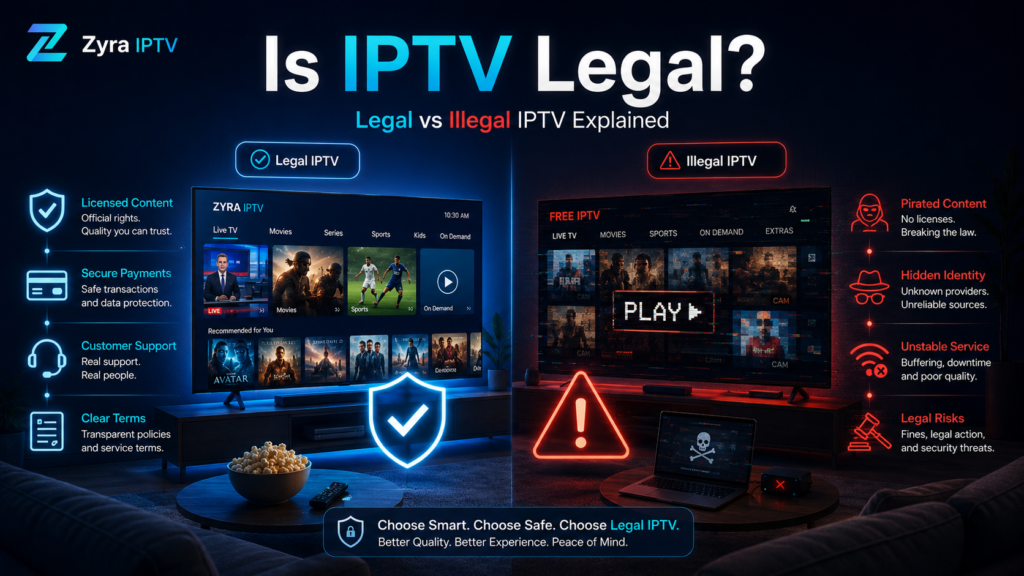
Is IPTV legal? Yes, IPTV technology itself is legal. The legal issue is not the technology used to deliver television, but whether the provider has permission or appropriate rights to distribute the channels, movies, sports, and other content it offers. Legitimate broadcasters, telecommunications companies, and streaming platforms can all use Internet Protocol technology to deliver television. Problems arise when a service retransmits copyrighted content without authorization from the relevant rights holders. Because copyright rules differ by jurisdiction, the legal position of a particular service or user cannot be determined from the word “IPTV” alone. This guide explains the distinction and highlights important differences for viewers in Australia, the United States, and Canada. If you are new to the technology, the Zyra IPTV guide explaining what IPTV is provides a useful introduction. What Makes an IPTV Service Legal or Illegal? IPTV stands for Internet Protocol Television. It describes a method of delivering television through IP-based networks. The technology itself does not determine whether a service is lawful. The central question is usually content authorization. A provider may need permission or licences from broadcasters, studios, sports organizations, networks, distributors, or other copyright owners before making protected programming available to subscribers. A simple comparison is: Legal IPTV Potentially illegal IPTV Distributes content with appropriate authorization Distributes copyrighted content without required permission Provides content it has the right to offer Retransmits channels, movies, or sports without distribution rights Operates subject to applicable copyright and broadcasting rules Relies on unauthorized copies or streams Makes its service terms and business information reasonably clear May provide little information about where content rights come from A low price, unusual payment method, or large channel lineup does not by itself prove that an IPTV service is illegal. Licensing arrangements are not always visible to consumers, so legality should be assessed using reliable evidence rather than assumptions. Why Copyright Licensing Matters Television programs, films, sporting broadcasts, and other media are commonly protected by copyright. Copyright owners generally control specific uses of their material, including reproduction, communication, distribution, or public performance depending on the jurisdiction. In Australia, the Attorney-General’s Department explains that copyright owners have exclusive rights that include copying, communicating, and publicly performing protected material. Using a protected work in a way reserved for the copyright owner without permission can amount to infringement unless an exception applies. The same basic principle appears in the United States and Canada, although the exact laws, remedies, offences, and exceptions differ. This is why asking “are IPTV services legal?” requires looking at the service’s content rights, not simply whether it streams over the internet. Is IPTV Legal in Australia? IPTV technology is not inherently illegal in Australia. Australian copyright law protects material including films and television broadcasts. The Australian Attorney-General’s Department states that copyright infringement generally occurs when someone performs an act reserved to the copyright owner without permission, subject to statutory exceptions. Therefore, an IPTV platform that has the necessary rights to distribute its programming can operate lawfully from a copyright perspective. A service that retransmits protected programming without authorization may raise copyright infringement issues. Australia also has mechanisms directed at online copyright infringement, so consumers should not assume that the internet-based nature of a service removes normal copyright requirements. For a specific service or situation, legal advice from an Australian professional may be necessary. Is IPTV Legal in the United States? IPTV technology is also legal in the United States, but unauthorized streaming can violate federal copyright law. The U.S. Copyright Office has stated that unauthorized streaming can implicate a copyright owner’s public performance right. Federal authorities have also prosecuted operators of unauthorized streaming and IPTV services. In one IPTV case, the U.S. Department of Justice described a scheme in which operators allegedly obtained television programming and resold copyrighted content to subscribers without authorization. More recently, the Department of Justice seized hundreds of domains that it said were streaming 2026 FIFA World Cup matches without authorization. These enforcement examples mainly concern providers, operators, and unauthorized distribution. They should not be interpreted as meaning that every person using an IPTV application automatically commits the same offence. The legal consequences for an individual viewer depend on the person’s conduct, the applicable law, and the facts of the case. Is IPTV Legal in Canada? Canada follows the same broad distinction between IPTV technology and unauthorized use of copyrighted content. The Canadian Intellectual Property Office explains that copyright infringement can occur when protected content is used in a manner that violates rights granted under the Copyright Act, such as copying or communicating protected material without authorization. It also emphasizes that only a court can ultimately determine whether infringement has occurred in a particular case. There is another important Canadian distinction. The Canadian Radio-television and Telecommunications Commission explains that services streaming content over the internet do not need a conventional CRTC broadcasting licence simply because they operate online. However, whether content may be made available still depends on distribution rights. In other words, not needing a particular CRTC licence does not mean a provider automatically has copyright permission for every channel or program it offers. Is an IPTV App Legal? Usually, the existence of an IPTV app or player is not what determines legality. An IPTV player can simply be software that receives and displays streams. The same application might be used with authorized content in one situation and unauthorized content in another. For example, an app may support: Those technical capabilities do not prove whether the content itself is licensed. The better question is not simply “is this IPTV app legal?” but “does the service or content loaded into this app have the required rights?” An app being available through a well-known app store also should not be treated as conclusive evidence about the licensing status of every third-party stream that can be loaded into it. For a deeper explanation of the delivery process, see Zyra IPTV’s guide to how IPTV works. How Can You Assess Whether an IPTV Service Is Legitimate? Consumers often cannot
How Does IPTV Work? IPTV Technology Explained Simply
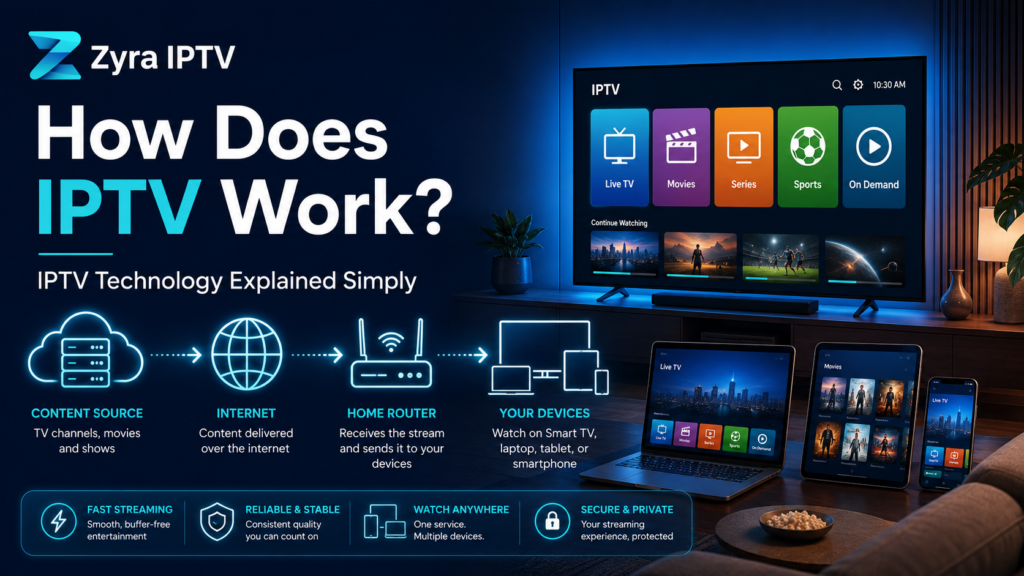
How does IPTV work? In simple terms, television content is converted into digital video, delivered through an IP-based network, received by an IPTV app or device, and decoded into the picture and sound you watch. Behind that simple process are several stages, including content acquisition, video encoding, servers, network delivery, authentication, buffering, and playback. You do not need to understand all of the technical details to use IPTV, but knowing what happens between the source and your screen makes IPTV much easier to understand. If you are unfamiliar with the term itself, Zyra IPTV’s beginner guide to what IPTV is explains the basic definition and terminology. What Is IPTV and How Does It Work? IPTV stands for Internet Protocol Television. Instead of relying only on traditional terrestrial, satellite, or cable transmission, IPTV uses Internet Protocol technology to deliver television and multimedia content. In formal telecommunications standards, IPTV is associated with multimedia services delivered through IP-based networks designed to support requirements such as quality of service, interactivity, security, and reliability. In everyday use, however, people often use “IPTV” more broadly when referring to television delivered through an internet-connected network. The easiest way to understand how IPTV works is to follow a programme from its original source to the viewer. How IPTV Works Step by Step 1. Television Content Enters the IPTV System Everything starts with content. For live TV, the source might be a television channel or another live video feed. Movies, TV series, and other video-on-demand content may already exist as stored digital files. The IPTV platform first needs to receive or ingest this content before it can make it available to viewers. 2. Video Is Encoded and Compressed Raw video can require a large amount of data, so it is normally encoded into a format suitable for digital distribution. Encoding compresses the video so that it can travel across a network more efficiently while retaining an appropriate level of picture and sound quality. Common television and streaming systems use video compression standards to reduce the amount of data that must be transmitted. The exact codec, resolution, bitrate, and encoding method depend on the platform rather than IPTV having one universal format. APNIC’s technical explanation of IPTV describes transcoding as an important stage between television content and IP delivery. 3. The IPTV Platform Organises the Content Once prepared, content has to be organised and made available to users. An IPTV platform can include servers and software responsible for functions such as: This is also where terms such as EPG, middleware, playlists, and authentication often appear. An EPG, or Electronic Programme Guide, contains information about television schedules. A playlist such as an M3U may contain references to streams that a compatible player can read. Neither feature is required to work identically across every IPTV system. How Does IPTV Send Live TV to Viewers? This is one of the most important parts of IPTV technology. IP networks can deliver video in different ways. Two terms commonly associated with IPTV are multicast and unicast. Multicast for Live Television In a managed IPTV network, multicast can be used for linear live television. With multicast, a network can distribute one stream efficiently to multiple viewers who are watching the same channel instead of generating an entirely separate source stream for every viewer. ITU standards describe multicast as a technology that can be used in managed IPTV networks for live broadcast services. When a viewer changes channels in such a system, the network can switch which television stream is being delivered to that subscriber. Unicast for Individual Requests Unicast works differently. It creates a one-to-one data flow between a server and a viewer. This makes it particularly suitable for video on demand because different viewers may choose different programmes and start them at different times. Modern IP video systems can use combinations of multicast, unicast, HTTP-based streaming, and other delivery technologies. IPTV should therefore not be understood as one single protocol. ITU guidance distinguishes between linear and non-linear IPTV services and notes the use of both unicast and multicast approaches. What Happens When You Select a Channel? From the viewer’s perspective, the process is much simpler. You open an IPTV application or interface and choose a channel or programme. The application uses the information available to it to locate or request the appropriate stream. A simplified sequence looks like this: These steps happen quickly and continue in the background while you watch. What Does an IPTV Player Actually Do? An IPTV player is the software responsible for receiving and presenting the content to the viewer. Depending on how the service is configured, a player may handle: The IPTV player should not automatically be confused with the IPTV service itself. A player can simply be software used to access streams or credentials supplied separately. The same principle applies to M3U playlists. An M3U file or URL can tell compatible software where media streams are located, but the playlist itself is not automatically an IPTV provider. What Devices Can Receive IPTV? An IP-based television service ultimately needs a device capable of receiving and displaying its content. Depending on the service, application, and supported configuration, that endpoint might be a television, set-top box, computer, mobile device, or audiovisual media player. ITU IPTV specifications recognise several types of terminal devices capable of processing and presenting multimedia content. For the viewer, the exact installation process depends heavily on the chosen platform. Zyra IPTV’s IPTV installation guides cover device-oriented setup information, while the Smart TV IPTV setup guide focuses specifically on television installation. Why Does IPTV Buffer? Buffering is closely connected to the way streaming video works. Before displaying video, the player normally keeps a small amount of incoming data available so that playback can continue even if delivery briefly fluctuates. If the player consumes video data faster than new data arrives, playback may pause while the buffer fills again. Possible causes include: This is why buffering cannot accurately be blamed on internet speed alone. Several parts of the delivery chain
What Is IPTV? Complete Beginner Guide to Internet Protocol Television
If you have heard people talking about IPTV and wondered what it actually means, the basic idea is simple. IPTV stands for Internet Protocol Television, a method of delivering television and video content through IP-based networks rather than relying only on traditional cable, satellite, or terrestrial broadcasting. Depending on the service, IPTV can provide live television, movies, TV series, video on demand, programme information, and other interactive features. You usually access the content through an internet-connected device and a compatible IPTV app or player. This beginner guide explains what IPTV is, how it works, what equipment you may need, and how it differs from other ways of watching television. What Does IPTV Stand For? IPTV means Internet Protocol Television. “Internet Protocol” refers to the technology used for transmitting data between devices across IP networks. Instead of receiving television solely as a conventional broadcast signal, an IPTV system delivers video as digital data. The International Telecommunication Union defines IPTV more specifically in the context of multimedia services delivered over IP-based networks that are managed to support factors such as quality of service, security, interactivity, and reliability. In everyday consumer language, however, people often use the term IPTV more broadly when discussing television services delivered using an internet connection. So, when someone asks “what’s IPTV?”, the simplest answer is: IPTV is television delivered using Internet Protocol technology rather than a traditional broadcast-only delivery system. How Does IPTV Work? Traditional television and IPTV can display similar content, but the way that content reaches your screen is different. With IPTV, television content is converted into digital data and delivered across an IP network. Your device or IPTV player receives the stream and turns that data into the video and audio you watch. A simplified IPTV process looks like this: This happens continuously while you watch. Live television may involve technologies designed for real-time delivery, while video-on-demand services normally send the selected programme specifically when a viewer requests it. IPTV standards can support both linear television and video-on-demand services. What Can You Watch With IPTV? The exact content depends entirely on the IPTV service being used. An IPTV platform may provide: Not every IPTV service includes every feature. Channel availability, video quality, catch-up functionality, EPG support, and on-demand libraries vary between providers. If you are comparing available programming, a provider’s IPTV channel information is more useful than assuming that every IPTV subscription offers the same lineup. IPTV vs Cable, Satellite, and Streaming Services IPTV is sometimes described simply as “internet TV”, but the terminology can become confusing because many modern services use internet-based video delivery. Here is a simple comparison: Method How content reaches you Typical experience IPTV IP-based network Live TV, on-demand video, programme guides, depending on the service Cable TV Physical cable network Scheduled television and provider features Satellite TV Satellite signal and dish Scheduled television and provider features Terrestrial TV Broadcast signal and antenna Local or national broadcast channels On-demand streaming Internet connection Mainly user-selected movies, series, and other video The boundaries are not always perfect. Modern television platforms frequently combine technologies, and IPTV itself covers several different network architectures. The important point is that IPTV describes how television content is delivered, not one particular company, app, subscription, or device. Is IPTV the Same as Netflix or Other Streaming Apps? Not exactly. Both IPTV and services such as conventional streaming platforms can deliver video using internet technology, but their service models may be different. IPTV often focuses more heavily on television-style experiences such as: A typical on-demand streaming platform is usually centred on choosing individual movies, episodes, or videos from a catalogue. There is considerable overlap, so it is more accurate to think of IPTV as a television delivery technology rather than simply another name for every streaming service. What Do You Need to Use IPTV? A basic IPTV setup normally involves several components. An Internet or Network Connection The video data has to reach your device through a network connection. Streaming performance can be affected by available bandwidth, Wi-Fi conditions, network congestion, the selected video quality, the IPTV platform, and the device being used. Higher-resolution video generally requires more network capacity than lower-resolution video. A Compatible Device Depending on the IPTV service and player, viewing devices can include: Compatibility should always be checked with the service and app rather than assumed. Zyra IPTV provides separate instructions for users who need help with Smart TV IPTV setup and Android TV IPTV setup. An IPTV App or Player An IPTV player is the software that loads and displays the television stream. An important distinction for beginners is that an IPTV player and an IPTV service are not necessarily the same thing. A player may simply provide the interface needed to use access information supplied by a service. Service or Access Details Depending on the platform, access may be provided through login credentials, a playlist, a server address, a portal, or another supported configuration method. The exact setup process varies. The IPTV installation guides provide device-specific starting points instead of applying one setup method to every platform. Common IPTV Terms Beginners Should Know You will probably encounter several terms when researching IPTV. IPTV Player Software used to load, organise, and display IPTV streams. M3U M3U is a playlist format that can contain references to media streams. Some IPTV systems use an M3U URL or file to make available streams accessible through compatible software. An M3U playlist itself is not the television service. It is a way of organising or referencing media locations. EPG EPG stands for Electronic Programme Guide. It provides schedule information similar to the television guide found on traditional cable or satellite systems. EPG availability and accuracy depend on the service and configuration. VOD VOD means Video on Demand. Instead of joining a live programme already in progress, you select available content and begin watching it when you choose. Live TV Live IPTV streams are intended to show programming as it is being transmitted, similar to traditional live television. Catch-Up TV